
Please note: This article is for informational purposes only and is not intended as investment advice. The mention of specific stocks is not a recommendation to buy or sell any securities.
Nintendo just dropped their full-year earnings report for the fiscal year ending March 2026.
I did write that I think the market is far too bearish on the Nintendo stock last week:
As the earnings are finally out, we can finally see if I was right or wrong!
So sit down, grab a coffee, and let us analyze it in detail:
The initial shock and awe
Let us look at the top-line consolidated operating results for the fiscal year ended March 31, 2026. The absolute numbers are staggering. The Switch 2 launch single-handedly resuscitated the entire top line.
Net sales hit 2,313.0 billion JPY, which is an astronomical 98.6% increase year-over-year.
Gross profit reached 908.9 billion JPY, climbing by 28.0%.
Operating profit landed at 360.1 billion JPY, representing an increase of 27.5%.
Ordinary profit stood at 542.1 billion JPY, jumping a massive 45.6%.
Profit attributable to owners of the parent was 424.0 billion JPY, marking a 52.1% spike.
Any normal company would celebrate a 52% increase in net profit. However, the market seems to have completely ignored the profit growth and hyper-focused on the margins. The gross profit ratio plummeted by 21.7 percentage points, dropping from 61.0% to 39.3%.
Operating profit margins also took a severe beating. The operating margin fell from 24.3% in FY2025 down to 15.6% in FY2026.
Dissecting the profitability collapse
The reality is that early hardware cycles are notoriously unprofitable, but Nintendo used to be the exception because they have always relied on cheap, commoditized components to turn a profit on hardware from day one.
That strategy is currently failing because the memory market is utterly broken. The intense expansion of artificial intelligence infrastructure has created a massive boom cycle. There is insatiable demand for DRAM memory and NAND storage across the globe.
Manufacturing this advanced AI memory requires roughly triple the wafer space of standard memory chips. This dynamic is effectively cannibalizing the production capacity for standard components. The LPDDR5X RAM used in consumer electronics is suddenly scarce and wildly expensive.
Let us look at the raw cost increases that Nintendo is currently battling.
A standard 16GB DDR5 chip was trading at approximately 6.84 USD in September 2025. By late 2025, that exact same chip surged past 24.00 USD.
This represents a catastrophic price increase of roughly 300% in a matter of months.
Counterpoint Research notes that overall DRAM prices increased by 50% year-to-date and will rise another 30% soon.
When a gaming console has to bid for silicon against a trillion-dollar AI behemoth, the gaming console is going to suffer. This is the root cause of the margin compression. But it’s quite obviously a cyclical supply shock, not a fundamental flaw in Nintendo’s business model.
Switch 2 price hike
Sadly, the memory cost is just one piece of the margin compression. The company has baked an estimated 100 billion JPY impact into their FY2027 cost of goods sold. This massive headwind consists entirely of rising component prices and aggressive US tariff measures.
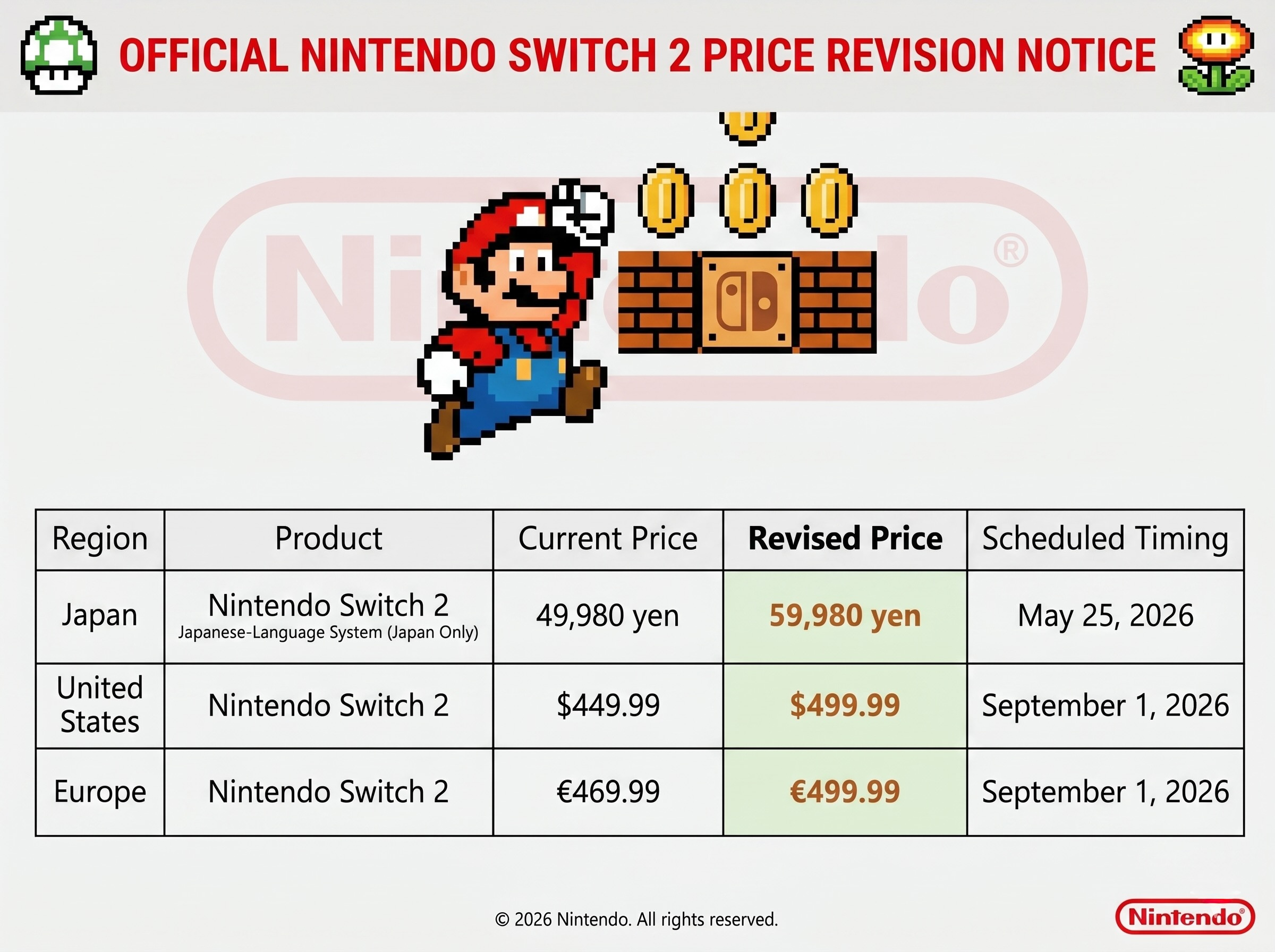
Faced with a hardware unit being sold at an estimated loss, Nintendo had to make a brutal choice. They could either continue subsidizing the hardware or they could hike prices. Management finally acted to protect their bottom line.
The following list outlines the sweeping hardware price revisions scheduled for the new console:
Look closely at the timing of these price hikes.
By delaying the US and European hikes until September, Nintendo has effectively created a four-month artificial sales event. Fence-sitters will rush to buy the console at the cheaper 449.99 USD price point before the holiday season begins.
Despite all the profitability concerns, the sheer volume of hardware moving off the shelves is staggering. The Switch 2 achieved 19.86 million unit sales during its first fiscal year on the market. This adoption rate actually outpaced the original Switch in its first full fiscal year.
Here is the geographical breakdown of Switch 2 hardware sales for FY2026.
The Americas led the charge with 6.73 million units sold.
Japan followed closely behind with 5.66 million units.
Europe contributed a solid 4.40 million units.
Other regions combined for 3.06 million units.
For FY2027, management forecasts 16.50 million Switch 2 hardware sales. This represents a 16.9% year-over-year decline from the launch year highs. This expected drop simply reflects the concentration of early adopters and the anticipated friction from the upcoming price hikes.
Nintendo’s software sales & pipeline
If hardware is the loss leader dragging down gross profits, software is the high-margin savior keeping the entire enterprise afloat. First-party software sales accounted for 74.7% of total dedicated video game platform software sales in FY2026. This is the ultimate competitive advantage in the gaming sector.
Let us look at the million-seller first-party titles for the Switch 2 in FY2026.
Mario Kart World completely dominated, selling 14.70 million units globally.
Donkey Kong Bananza pulled in a very respectable 4.52 million units.
Pokémon Legends: Z-A (Switch 2 Edition) moved 3.94 million units.
Pokémon Pokopia sold 2.41 million units outside of Japan.
Kirby Air Riders found success with 1.87 million units sold.
Mario Kart remains an unstoppable cash cow for this company. You cannot find a more reliable recurring revenue stream in the entertainment industry.
While the legacy software sales and the Switch 2 launch titles are impressive, I must address the elephant in the room. If you look at the announced first-party Switch 2 titles for the rest of 2026, the list is frighteningly sparse.
We have Yoshi and the Mysterious Book slated for May and Star Fox in June. Splatoon Raiders will officially launch on July 23, 2026. Later in the year, we get Fire Emblem: Fortune’s Weave.
These are great franchises, but they do not scream system sellers. Nintendo has worryingly failed to provide a release date for a new mainline 3D Super Mario, Super Smash Bros, or Zelda title - their top console sellers!
Competitors are gearing up for massive cultural releases like Grand Theft Auto VI in November, and Nintendo is currently bringing B-tier franchises to an A-tier fight. This weak pipeline is a legitimate threat to their short-term hardware adoption and software projections.
On a brighter note, a quiet revolution is happening within Nintendo’s revenue streams. The company is slowly but surely transitioning its massive user base toward high-margin digital consumption. In FY2026, digital sales totaled 407.6 billion JPY, representing a fantastic 25.0% year-over-year increase.
Digital sales now account for a record 54.6% of total dedicated video game platform software sales. Every time a consumer downloads a game instead of buying a physical cartridge, Nintendo bypasses manufacturing costs and retail margin haircuts. The digital transition is a massive, slow-moving catalyst for future profitability.
Furthermore, Nintendo recently announced subscription fee increases in Japan for Nintendo Switch Online. They are pushing the annual individual membership from 2,400 JPY to 3,000 JPY starting July 1. This represents a 25% price hike on pure-profit recurring revenue.
Balance Sheet Analysis & Dividend Policy
If there is one legitimate criticism to level at Nintendo’s management, it is their wildly inefficient capital allocation strategy. The company operates with a balance sheet fortified like a doomsday bunker.
Total assets increased to a staggering 3,805.3 billion JPY.
Cash and deposits sit at an astonishing 1,791.8 billion JPY.
Total liabilities are a mere 850.1 billion JPY.
They could fund operations for decades without selling a single video game. Nintendo treats cash as a sacred relic to be hoarded at all costs. This massive cash position puts a hard floor on the stock price, but it destroys return on equity.
However, management did announce a significant revision to their profit distribution policy. The annual dividend is now established at an aggressive 60% consolidated payout ratio.
For the fiscal year ended March 31, 2026, the total annual dividend reached a generous 219 JPY per share - that’s a 2.9% dividend on today’s share price.
Even with conservative FY2027 guidance, the forecasted annual dividend sits at a very respectable 162 JPY per share.
Conclusion
The FY2026 earnings report does confirm my original thesis, but the risk profile has fundamentally shifted. I think the numbers clearly show that underlying value of this company is completely unshakeable in the long term. However, the short-term headwinds are undeniable and far more severe than just cyclical memory pricing spikes.
Nintendo successfully transitioned a massive user base to new hardware, selling nearly 20 million units in a single year. They increased their digital sales ratio to over 54% and raised their dividend payout to 60%.
The absence of flagship titles like Super Mario or Zelda this holiday season will act as a heavy anchor on Nintendo’s stock. A hardware margin squeeze combined with a barren software pipeline guarantees a rough few quarters ahead. You are looking at a premium brand currently stalling on near-term execution.
The critical question remains: is this bleak outlook already priced into the stock?
I think yes!


Thanks for this. The snap feeling on this seems to be that they should buy back as much stock as possible. But they probably won't!