
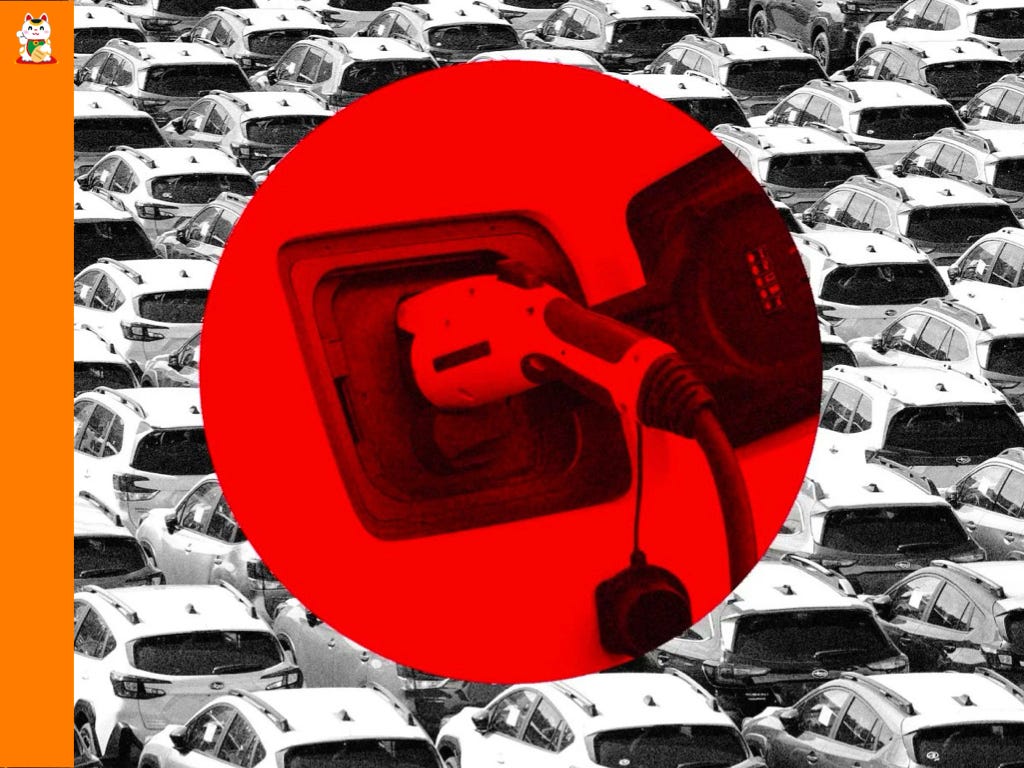
What Happens When Japan’s Car Industry Collapses?
Can Japan's auto giants really survive the new electric world order?
I was recently scrolling through videos of China’s newest automotive assembly lines, and honestly, it’s scary. I was looking at so-called “dark factories”, facilities like those operated by Xiaomi and BYD. They are so thoroughly automated they can operate in the dark, with basically zero human interaction, and a completed car rolls off the line every 100 seconds.
Watching this, a grim question hit me: How on earth can Japan, burdened by its massive legacy workforce and factories, compete with that?
For over half a century, Japanese cars set the global standard for reliability, efficiency, and mechanical engineering. Brands like Toyota, Honda, and Nissan transformed Japan into a global economic superpower. But the automobile is no longer the mechanical marvel of the 20th century; it is becoming a computer on wheels.
This is a look at what happens if Japan’s auto industry collapses.
But first:
Why it’s stupid to make both EVs and ICE cars
For years, Japanese automakers, led prominently by Toyota, have championed a multi-pathway strategy, arguing that customers demand a mix of internal combustion engines (ICE), hybrids, plug-in hybrids; before the car industry transitions to full EVs. And because hybrid vehicles have generated record profits recently, they feel financially validated.
But here is my core thesis: You cannot just start investing more in EVs when the “time is right” and hope to catch up simply because you have a lot of money from your hybrid segment.
Running an ICE factory and an EV factory simultaneously is an absolute logistical and financial nightmare. You will always be vastly more inefficient running dual platforms, splitting your R&D budget, maintaining dual supply chains, and managing two entirely different workforces, compared to a pure-play EV competitor.
Can Japanese automakers catch up?
Do companies like Toyota, Nissan or Honda even have a chance to catch up? And how would that realistically work?
Toyota’s master plan relies almost exclusively on a huge technological leapfrog: The commercialization of solid-state batteries by 2027 or 2028.
If successful, it would double range, slash charging times to minutes, and potentially reset the whole EV board. Right now, though, it feels more like wishful thinking than a sure thing. At this point, it’s a hope, not a promise. We still don't know if the tech works, and actually mass-producing it is going to be a massive roadblock.
In fact, Toyota claimed to have working solid-state batteries in 2013, 2016, 2017, 2020, and 2022, promising a launch 'in the next two years' every single time. This time might be different, but do not put your hopes up.
Then there is the software gap.
The competitive edge today lies in Software-Defined Vehicles (SDVs). Modern car owners expect their cars to improve over time via Over-The-Air (OTA) updates. Toyota is currently rolling out its Arene operating system, proudly announcing that their fleet will be true SDVs by 2026.
But look at the sheer reality of the gap: Last year, BYD pushed out roughly 200 OTA software updates to continually refine their vehicles; Toyota managed about 8…
Catching up requires a complete dismantling of Japan’s hierarchical, perfectionist corporate culture, and I am highly skeptical they can move fast enough to close a gap this wide.
How will Japanese automakers fall?
Take this with a grain of salt as I've only consulted for Japanese automakers on minor projects, but I see their decline unfolding in three phases over the next decade:
Phase 1: Losing Emerging Markets (Years 1 to 3): The first domino to fall is Southeast Asia. Historically, this has been a Japanese fortress with up to 90% market share, but the region is rapidly adopting EVs. Chinese OEMs, facing brutal price wars at home, are aggressively exporting and localizing production in places like Thailand. The Japanese monopoly in the Global South is already breaking.
Phase 2: Financial Strain (Years 4 to 7): As global sales contract, the fixed costs of operating legacy assembly plants will become an unbearable weight. Earnings guidance will be slashed, and the massive cash reserves held by companies like Toyota will burn rapidly as they frantically try to fund their delayed EV platforms.
Phase 3: The Hollowing Out of the Supply Chain (Years 8 to 10): Unable to sustain operations, major automakers will be forced to close domestic plants. Because ICE cars require thousands of specialized parts that EVs do not, most of Japan's huge network of Tier-2 and Tier-3 suppliers will not be needed, triggering a wave of mass bankruptcies. While giants like Toyota will likely survive, their footprint will fundamentally change. The majority of their domestic factories will face closure or outsourcing, resulting in hundreds of thousands of job losses.
If the auto supply chain starts collapsing, I think the Japanese government will step in, but political instinct will likely not be to force painful, necessary innovation. It will be to pump endless capital into failing suppliers to prevent unemployment. Keeping these zombie factories on life support will only drain resources from the startups and tech firms that actually need the capital, accelerating the broader economic stagnation.
If this were to happen, the numbers paint a grim picture of a nation losing its primary engine of wealth generation.
In 2024, auto manufacturing comprised 2.9% of Japan’s GDP. More importantly, motor vehicle exports made up 21% of the nation’s gross exports. If these exports evaporate, Japan faces a permanent structural trade deficit, leading to a perpetually weak Yen and crushing imported inflation.
If Autos collapse, what’s Japan’s substitute?
The obvious answers are advanced semiconductors and industrial robotics.
Already recognizing the strategic threat, the Japanese government is pouring $25.7 billion into a chip renaissance, subsidizing massive TSMC plants and launching state-backed ventures like Rapidus to build 2-nanometer chips. Furthermore, Japan remains the undisputed king of industrial robotics, currently producing 38% of the global supply through giants like FANUC and Yaskawa.
But there is a brutal catch: You cannot replace a car factory with a chip fab when it comes to human beings.
The automotive sector employs over 8% of Japan’s workforce. A $1 billion auto plant employs thousands of blue-collar workers and supports entire regional towns like Toyota City in Aichi Prefecture. A modern semiconductor plant is highly automated and employs only a fraction of that number, requiring highly specific advanced degrees in chemistry and physics.
While a thriving chip and robotics sector will generate massive corporate wealth and keep Japan globally relevant, it won't absorb millions of displaced assembly line workers. Very few jobs offer automotive-level wages without requiring extensive specialized education. Consequently, these laid-off workers will likely never find comparable employment, inevitably hollowing out Japan’s middle class and guaranteeing a grim future for this demographic…
My final take
It should come as no surprise that I am strictly avoiding Japanese automakers as an investment.
The story that companies like Toyota can simply coast on hybrid profits while they figure out software and manage to leapfrog all current battery manufacturers by releasing the world’s best EV batteries 2027 is risky to say the least.
Also, running inefficient dual ICE/EV platforms against hyper-agile Chinese competitors operating fully automated “dark factories” for EVs only is a losing battle.
Unless Japanese automakers can miraculously execute their solid-state battery gamble on time, completely overhaul their software development cultures, I think there is a real chance of their total collapse!
Japan will survive, but its economy will sharply divide. The highly educated elite will continue to succeed in modern industries like semiconductors. But a big part of the broad, comfortable middle class, the backbone of the post-war auto boom, will disappear.
If you wanna dive deeper into the death of the Japanese car industry, watch my video on it here:


