



It is June 2026, and the financial laws of gravity are completely breaking down across two different hemispheres.
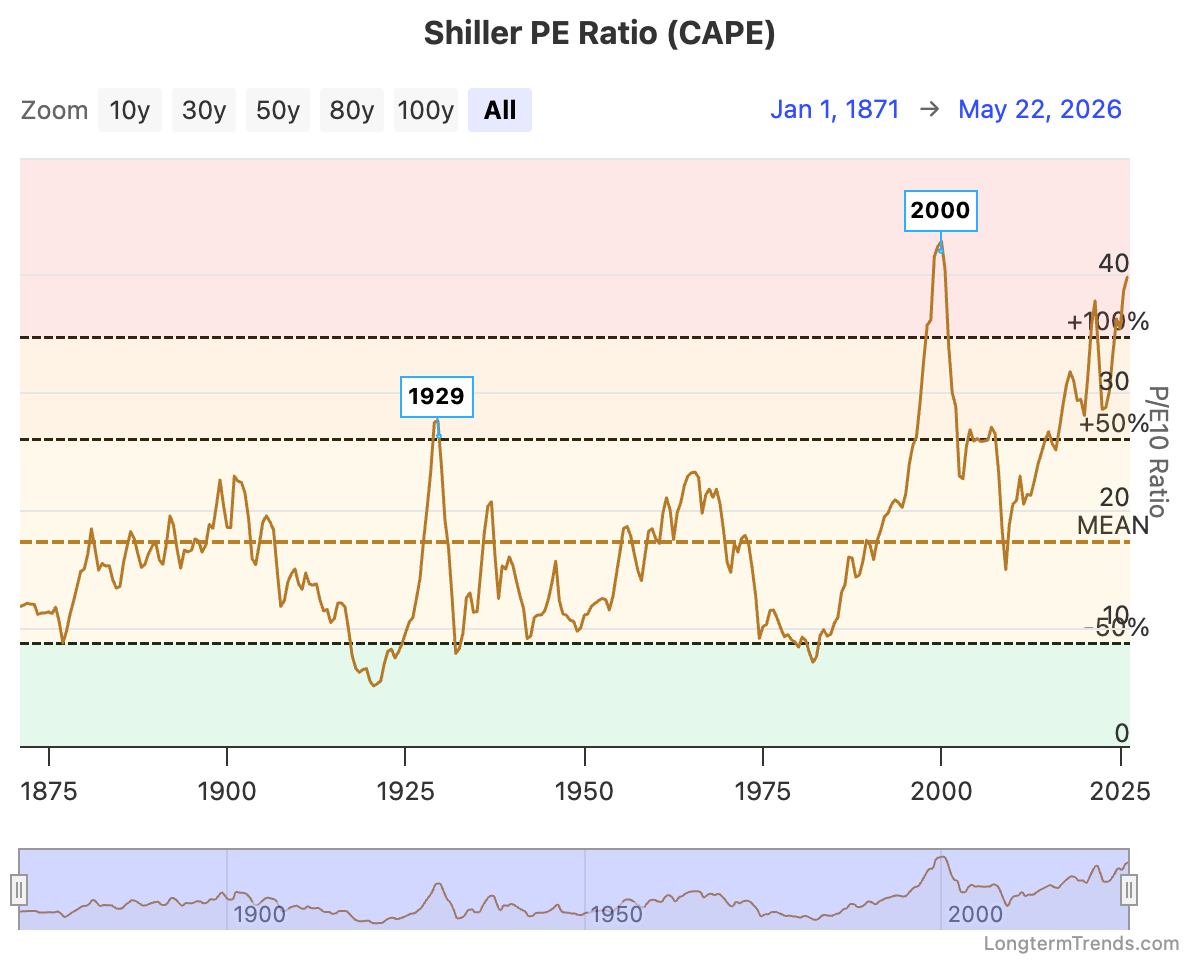
The US stock market has reached valuations that defy all historical sanity. The S&P 500 is currently sitting at a massive 41.6 on the Shiller P/E. As a refresher, this metric smooths out the normal ups and downs of the economy by looking at ten years of profits instead of just one. In plain English, a 41.6 ratio means investors are paying nearly $42 today for every $1 of profit those companies averaged over the last decade.
To understand how insane that is, you have to look at 140 years of market data. The current valuation is more than twice the long-run historical average of 17.3. We have officially blown past the infamous 1929 peak of 32.6, which preceded the Great Depression. We even crushed the post-pandemic stimulus peak of 38.6. There is only one single moment in the entire history of American capitalism when stocks were more expensive than they are today. That was December 1999, right at the peak of the dot-com bubble, when the Shiller P/E hit 44.19.
Meanwhile, over in Japan, I am seeing a totally different milestone. The Nikkei 225 just broke 65,000 and hit an intraday all-time high of 66,428.81 in late May 2026. Japan spent over three decades trapped in the shadow of its own legendary crash. But unlike the current American market, Japan’s rally is not built on speculative AI euphoria. Japan’s CAPE ratio (Shiller P/E) is sitting at a quite reasonable 29.38. That is elevated globally, but it is nothing like the hallucinatory valuations Japan saw during its 1989 ultra-bubble, when their CAPE approached 100.
