
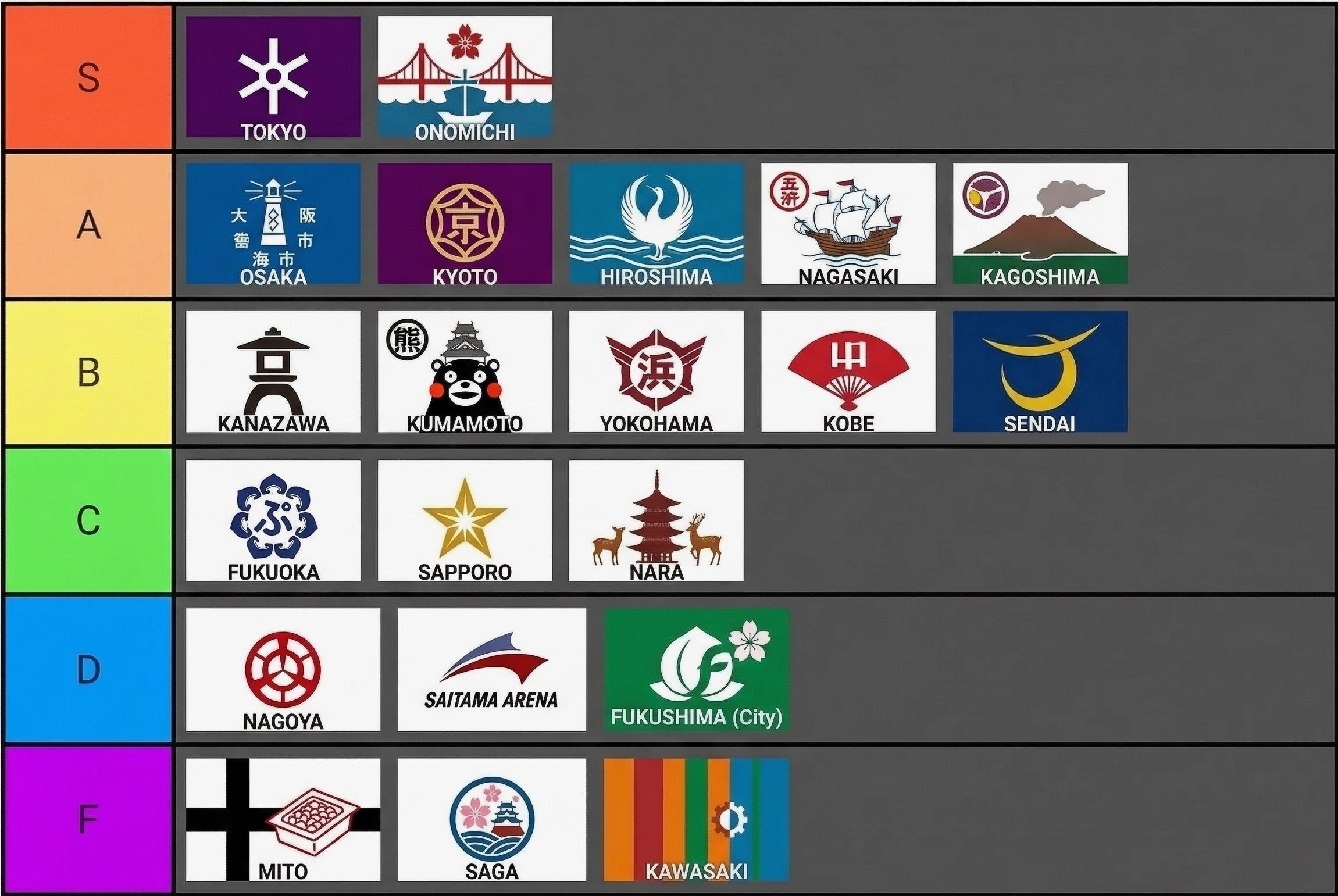
Listen, Japan is amazing. It’s the land of the rising sun, unparalleled service, and convenience stores that will ruin your life back home. But contrary to your gaijin beliefs, not every city is a neon-soaked cyberpunk dreamland. Some cities are just concrete, car centric hellscapes peppered with pachinko parlors and chain restaurants…
So, channel your inner Chris Broad, grab a Strong Zero, and let’s rank these cities:
S-Tier
Tokyo
Rank: S-Tier
Verdict: Do I even need to say anything?
The world’s biggest city (Jakarta doesn’t count!). To attempt to classify Tokyo alongside standard global municipalities is an exercise in profound analytical futility; it does not function as a mere city, but rather as a sprawling, hyper-dense nation-state operating under its own gravitational laws. It’s so densely packed with skyscrapers, Michelin restaurants, and cheap bars that will give you more fun nights than a year in any other city, that every other metropolis on Earth is jealous. I wouldn’t even consider it a city; it’s like 7 cities mashed into one.
Upside: The sheer, unadulterated volume of peak human experiences available within a thirty-mile radius is staggering. You have the insanely iconic and touristy Shibuya, to the perhaps even more touristy nightlife district Shinjuku, to the hipper and more vintage-than-life-itself Shimokitazawa. Then you have Jimbocho, classic and incredibly cool, selling the best of any hobby thing you can think of. And Asakusa, with its incredible old Japan vibe peppered with Kappabashi where you can find the world’s sharpest knives. I’ve mentioned five areas, but I could easily go on with another 30!
Downside: Hotels are way overpriced and expensive compared to the rest of Japan (even though it’s still cheaper than almost any other megacity). The baseline cost of existing in the central wards has skyrocketed, and the dynamic pricing of accommodations during peak seasons can brutally eviscerate a standard travel budget.
Onomichi
Rank: S-Tier
Verdict: Small town, massive cycling energy.
You might think I am joking, but hear me out! It is tiny, but everything is weirdly charming. Nestled along the Seto Inland Sea, it punches impossibly far above its weight class.
Upside: More than anything, it is the gateway to Shimanami Kaido, the most beautiful cycling path in all of Japan (maybe the world?). Tons of hip cafes have been started in the city because this is such a tourist hot spot, and for people who love cycling like me, there’s more cycling rental shops than anywhere else per capita :P.
Downside: Because it caters so heavily to the cycling crowd, if you aren’t interested in biking or cafe-hopping, the immediate urban footprint is quite small and you might exhaust your options relatively quickly.
A-Tier
Osaka
Rank: A-Tier
Verdict: More charming than even Tokyo.
If the capital represents the polished, bureaucratic face of the nation, Osaka is its loud, pragmatic, and hilariously boisterous counterweight. Operating under the localized philosophy of kuidaore—the concept of eating and drinking oneself into total financial ruin—the city functions as the undisputed culinary engine of the archipelago.
Upside: If you like a good deal, Osaka is the place! Dirty cheap izakayas, the world’s largest underground city (Umeda Dungeon) with more bars than you have in your entire country, super fun people, and way more drunkards. The shopping is top-notch, and the social vibes are unmatched.
Downside: This city won’t open up as easily as Tokyo. You got to know the places if you don’t wanna end up on the same touristy paths as all the other foreigners eating overpriced takoyaki. It feels way smaller than Tokyo (and it is), and honestly, it can look a bit grimly if you don’t know where to look.
Kyoto
Rank: A-Tier
Verdict: Incredible city, even if it is overflowing with tourists.
Kyoto is the undisputed, heavily burdened historical soul of the nation. Spared from the devastating aerial bombardments of the mid-20th century, it retains an architectural and spiritual weight that simply cannot be replicated by the post-war concrete grids of its neighbors. Everyone in Japan will say things like “you should visit X, it’s the Kyoto of the north/south/west/east”, but the truth is, the Kyoto is the Kyoto of the world! Despite being overrun with tourists, it’s peak Japanese history!
Upside: It’s a must. Amazingly hip places, the most beautiful sights in all of Japan, super bike-friendly, and lots and lots of hidden gems if you dare to walk ten minutes away from the bus stop. It feels like “luxury” history.
Downside: Quite expensive, obviously too many tourists (especially the annoying kind), and the infrastructure is kinda breaking down under the weight of Instagrammers. Because it relies heavily on a surface-level bus network, the public transit is routinely paralyzed by hordes of visitors.
Hiroshima
Rank: A-Tier
Verdict: The comeback kid with a serious nightlife.
Hiroshima is a masterclass in urban resilience and psychological duality. It is a city that is globally synonymous with a singular, catastrophic historical event, yet it absolutely refuses to be defined solely as a somber mausoleum.
Upside: People come for the history, but stay for the vibe. It has a dual identity: profound, heartbreaking history by day at the Peace Park, and then a rowdy, “let’s drink until 4 AM” energy by night. The Okonomimura is a literal tower of okonomiyaki grills—it’s unpolished, unpretentious, and basically calorie heaven.
Downside: You can kind of “finish” the city in two days. Once you have absorbed the emotional weight of the Peace Park and taken the ferry ride out to the floating torii gate of Miyajima, the immediate urban core offers diminishing returns.
Nagasaki
Rank: A-Tier
Verdict: A stunning, topographically absurd cosmopolitan port.
Tucked away on the extreme western edge of the southern island of Kyushu, Nagasaki is a geographical and historical anomaly. For centuries, it was the sole window to the outside world, resulting in a fascinating architectural and cultural synthesis. Also, it’s right next to some of Japan’s most spectacular tourist destinations.
Upside: The pacing of this city is immaculate. It completely abandons the hyper-anxious, go-go energy of the central metropolises. They’ve also made their city and peninsula, which is dying out as the fastest shrinking major city in Japan, into something so interesting with the nearby abandoned island of Gunkanjima where the James Bond movie “Skyfall” was filmed. The history is incredibly layered, and the night view from Mount Inasa is routinely ranked as one of the best on the planet.
Downside: The logistics of reaching it are actively hostile to a tight itinerary. The extreme, punishing topography means that walking anywhere outside the immediate downtown grid involves navigating an endless, exhausting series of steep stone staircases.
Kagoshima
Rank: A-Tier
Verdict: The Napoli of Japan, but... far.
Positioned at the very southern tip of Kyushu, Kagoshima is a masterclass in sub-tropical, provincial pride. It is a city permanently defined by its dramatic geography and deep historical roots.
Upside: Okay, I love Kagoshima. It easily earns its A-Tier status because of the Saigo history and the accessible mountains you can hike nearby which are soo photogenic. Amazing views from all around of Sakurajima—it’s literally a volcano smoking in your face every day (”Too much volcano” maybe?). Amazing mountains, great Kurobuta pork, and charming small streets. It has zero tourists, which is very charming, and it’s the birthplace of the real last samurai, Saigo.
Downside: It’s just... really far away. The geographic isolation is its ultimate undoing. To reach it requires bypassing a dozen other world-class municipalities, making it a difficult sell for anyone not dedicating an entire trip solely to Kyushu.
B-Tier
Kanazawa
Rank: B-Tier
Verdict: The sophisticated, gold-plated samurai alternative to Kyoto’s crushing congestion.
Situated on the occasionally bleak, perpetually wet coast of the Sea of Japan, Kanazawa is a triumph of localized cultural preservation. Because it was the historic stronghold of the immensely wealthy Maeda clan, it cultivated an elite artisan culture.
Upside: The aesthetic preservation here is absolutely top-tier. You have access to Kenroku-en, an absurdly beautiful landscape garden completely free from the suffocating crowds of its Kansai rivals. The city is also famous for producing almost all of Japan’s gold leaf, meaning you can casually consume gold-flake-covered ice cream while wandering the immaculately preserved, wooden teahouses.
Downside: Yes, it is a much more chill Kyoto, but just as everyone says X is the Y of Paris, it will always be inferior to actually Paris, just like Kanazawa will always be inferior to Kyoto. With the recent extension of the Hokuriku Shinkansen, the secret is thoroughly out, and it is rapidly catching the same overtourism disease it used to be the cure for.
Kumamoto
Rank: B-Tier
Verdict: Birthplace so I’m biased, but hear me out.
Operating as a highly functional, highly pleasant regional capital in the center of Kyushu, Kumamoto represents the epitome of standard, high-quality Japanese provincial living.
Upside: Very charming, cheap, and has the best castle in all of Japan (sorry Himeji). It’s not huge on “things to do,” but it’s quite close to Japan’s biggest volcano, Aso. Overall, quite a charming city to just exist in.
Downside: If you aren’t into castles or volcanoes, you might run out of stuff to do by lunch. It lacks the massive commercial districts or explosive nightlife required to sustain a multi-day urban itinerary.
Yokohama
Rank: B-Tier
Verdict: Tokyo’s Chill Cousin.
By pure statistical metrics, Yokohama is a massive, world-class metropolis. However, its proximity to the capital completely dominates its psychological identity.
Upside: It’s massive, it has a huge Chinatown, and the waterfront at Minato Mirai is genuinely beautiful. It feels spacious and “luxury” compared to the cramped alleys of Tokyo.
Downside: It lives in Tokyo’s shadow. Why stay here when the main event is a 30-minute train ride away? Plus, they closed the moving Gundam, so the nerd factor dropped by 50 points.
Kobe
Rank: B-Tier
Verdict: A highly refined gastronomic harbor town with a surprisingly thin list of things to actually do.
Squeezed elegantly into a narrow, sloped strip of land between the mountains and the sea, Kobe exudes a sophisticated, slightly European atmosphere.
Upside: The city is incredibly beautiful, surprisingly calming, and highly walkable. The food scene is elite; dropping yen on A5 Kobe beef cooked over a teppanyaki grill is a culinary memory that will permanently ruin standard steak for you.
Downside: Once you eat the beef and look at the water, you quickly realize there isn’t actually that much heavy-hitting sightseeing to do here. It struggles to justify a multi-day tourist itinerary unless you just really, really want to keep eating expensive cows.
Sendai
Rank: B-Tier
Verdict: The highly functional king of the north that sits squarely on the wrong side of the country.
As the absolute administrative and commercial powerhouse of the Tohoku region, Sendai is a vibrant city affectionately known as the “City of Trees.”
Upside: It is a wildly comfortable city to exist in. The local food is phenomenal, primarily thick-cut, charcoal-grilled beef tongue (gyutan). Plus, it serves as the perfect launchpad for an easy day trip to Matsushima Bay.
Downside: Its fatal flaw is geography: traveling to Sendai means going the complete opposite direction of the highly demanded “Golden Route” (Tokyo-Kyoto-Osaka). It isolates it from standard itineraries.
C-Tier
Fukuoka
Rank: C-Tier
Verdict: Overrated. There, I said it.
Fukuoka is the darling of domestic livability surveys, highly praised as a highly optimized startup hub. However, from the perspective of urban exploration, it is a disappointment.
Upside: Amazing airport (literally in the city), and honestly the best ramen in Japan. Very affordable.
Downside: So ugly. Every time I go there I’m disappointed because people hype it up so much as the “best city to live in.” It has big city things like good shopping and luxury hotels, but it’s very small. The Truth: It’s a great place to live, but a boring place to visit (unless all you do is eat ramen, then it’s S-tier.)
Sapporo
Rank: C-Tier
Verdict: Just kinda boring and cold.
Constructed rapidly during the late 19th-century colonization of Hokkaido, Sapporo entirely abandoned the organic, winding alleyways of traditional Japanese urbanism in favor of a brutal grid system.
Upside: Look, the food is incredible. Soup Curry? Miso Ramen? Genghis Khan lamb? Yes, please. It’s also cheap.
Downside: But the city itself? It’s just a grid. A cold, snowy grid. The urbanism is bland, and unless you are there for the Snow Festival (which is crowded hell), it’s not very special. It feels like “Japan Lite” with more snow. It’s a long flight for just good dinner.
Nara
Rank: C-Tier
Verdict: A stunning, primal historical diorama crippled by a totally dead night economy.
Serving as Japan’s first permanent political capital long before Kyoto, Nara possesses a deep, rustic, and profoundly ancient atmosphere.
Upside: The sheer scale of the history here is staggering. The Tōdai-ji temple is a massive, awe-inspiring wooden structure. Feeding the famously “polite” bowing deer is a unique, highly marketable experience that charms millions.
Downside: Those “polite” deer are wild animals, and if you don’t surrender the crackers fast enough, they become highly aggressive. More importantly, the city basically ceases to exist after 5:00 PM, leaving the city feeling completely dormant once the sun goes down.
D-Tier
Nagoya
Rank: D-Tier
Verdict: The most boring city in Japan, ranked by the residents themselves. When residents in a 2016 Survey by Nikkei were asked what the best thing about Nagoya is, the top answer was “Easy access to other cities”.
Positioned squarely between the cultural supremacy of Tokyo and the chaotic charm of Osaka, Nagoya is the undisputed industrial void of the nation.
Upside: Their hotel and restaurant prices are way below other mega-cities on this list. Also, their Izakayas have top notch salarymen who love talking to strangers, and serve the best fried chicken in all of Japan!
Downside: The locals themselves practically voted the best thing to do in Nagoya is to leave Nagoya. It’s an industrial hub. It has wide roads for cars (gross) and lacks the chaotic charm of Osaka or the polish of Tokyo. It’s a stopover city. You eat a chicken wing, buy a 190 yen beer, you leave.
Saitama
Rank: D-Tier
Verdict: “Dasaitama” (Lame-Saitama).
Saitama is a massive, sprawling suburban purgatory located just north of Tokyo. It serves one singular purpose: to house the laborers who power the capital’s economy but have been priced out.
Upside: It offers relatively affordable residential zoning with incredibly efficient rail access directly into Tokyo.
Downside: It is the definition of a bed-town. It exists solely to house people who work in Tokyo but can’t afford Tokyo. It’s a suburban void. There is absolutely no reason for a tourist to be here unless you got lost on the train or you really, really like malls.
Fukushima (City)
Rank: D-Tier
Verdict: Grim vibes.
It is absolutely crucial to separate the city of Fukushima from the broader prefecture (which is genuinely spectacular). The capital city itself is an exercise in administrative depression.
Upside: It serves as a necessary, functional transit gateway to the vastly superior mountainous regions in the west.
Downside: I’m talking about the city, not the whole prefecture (Aizu is cool). But Fukushima city? It’s tough. It feels “much more grimly” than other places. Not easy to find cool places if you don’t know where to look, and it just lacks that “spark.”
7. F-Tier
Ibaraki
Rank: F-Tier
Verdict: Consistently voted the least attractive prefecture.
Situated to the northeast of Tokyo, Ibaraki is an aggressively flat, heavily industrialized zone that is locked in a perpetual struggle at the absolute bottom of domestic desirability metrics.
Upside: It produces massive quantities of natto (fermented soybeans) to feed the nation.
Downside: Every year there is a ranking of “most attractive prefectures” in Japan, and every year Ibaraki fights for last place. It’s the “Florida Man” of Japan but without the funny headlines. It’s industrial, flat, and ugly.
Saga
Rank: F-Tier
Verdict: Does it even exist?
Wedged pitifully between Fukuoka and Nagasaki, Saga is a vast expanse of agricultural zoning suffering from a terminal identity crisis.
Upside: The rural towns within the prefecture produce highly respected, historically significant ceramics (Arita ware).
Downside: Saga is so boring that there are memes about people forgetting it exists. It’s mostly rice fields. Locals joke that the only tourist attraction is the road out of Saga. It’s the “forgotten middle child” of Kyushu.
Kawasaki
Rank: F-Tier
Verdict: The Industrial Armpit.
Geographically trapped exactly between the immense cultural gravity of Tokyo and the affluent spaciousness of Yokohama, Kawasaki manages to capture the absolute worst characteristics of both.
Upside: The rail connections are highly efficient, allowing for an incredibly rapid evacuation in either direction. Good Vietnamese food!
Downside: Located between Tokyo and Yokohama, it somehow captured the worst of both worlds. It’s famous for factories, pollution, and a general “grimy” atmosphere. It’s dirty, industrial, and feels like the setting of a crime drama where nothing good happens.
Summary of Cities by Tier Classifications
S-Tier: Tokyo, Onomichi
A-Tier: Osaka, Kyoto, Hiroshima, Nagasaki, Kagoshima
B-Tier: Kanazawa, Kumamoto, Yokohama, Nara, Kobe, Sendai
C-Tier: Fukuoka, Sapporo
D-Tier: Nagoya, Saitama, Fukushima (City)
F-Tier: Ibaraki, Saga, Kawasaki


haven’t been to enough of these but how is Fukuoka C tier!?