
Please note: This article is for informational purposes only and is not intended as investment advice. The mention of specific stocks is not a recommendation to buy or sell any securities.
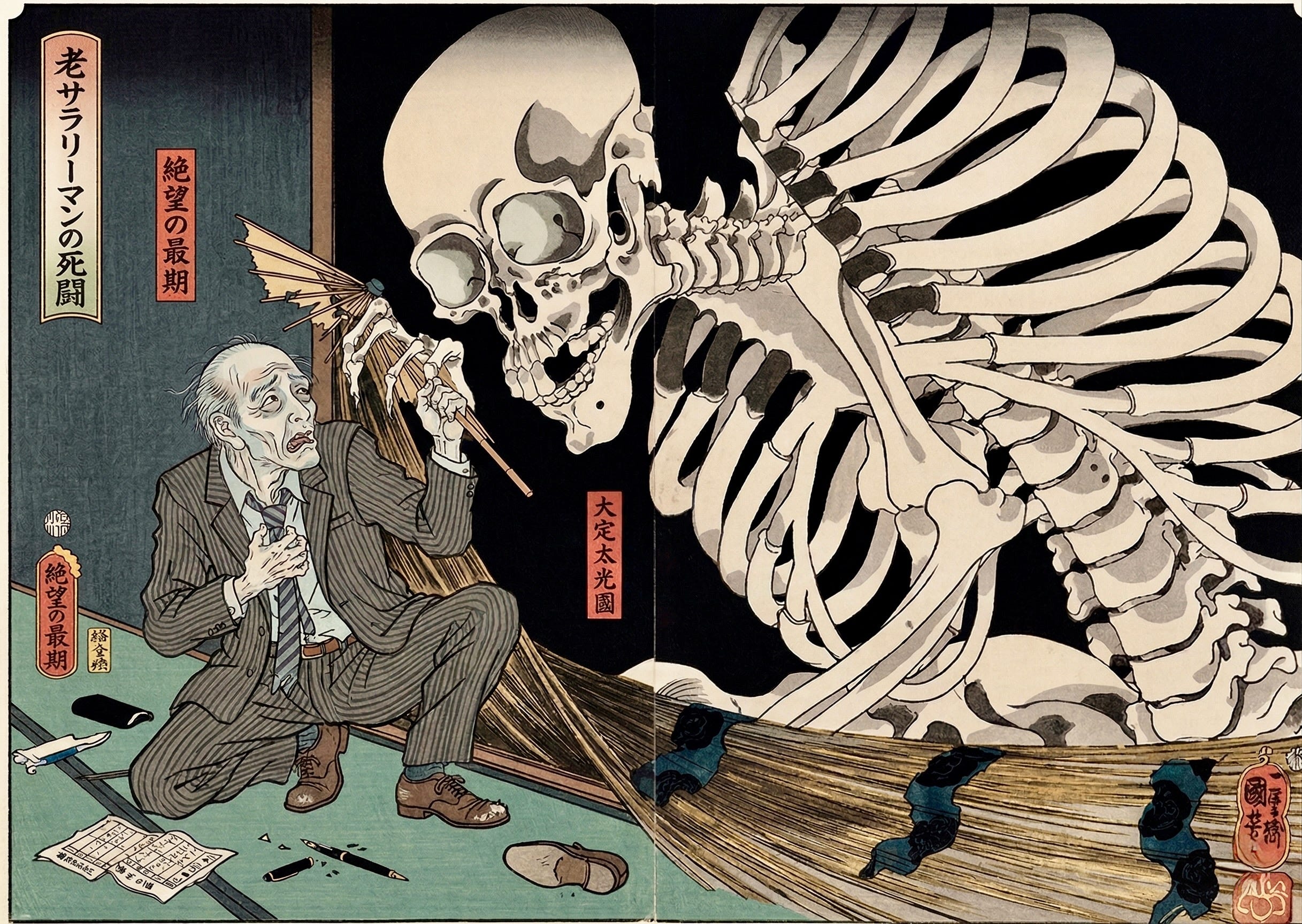
Japan Inc. is facing a demographic time bomb.
The scale of what is happening to Japan’s corporate landscape is truly terrifying:
Small and medium-sized enterprises are the bedrock of the Japanese economy, representing 99.7% of all businesses in Japan. Roughly two-thirds have no internal successor…
The Ministry of Economy, Trade and Industry (METI) calls this disaster the “2025 Cliff”. The permanent dissolution of these businesses threatens to erase upwards of 6.5 million jobs and vaporize approximately 22 trillion yen from Japan’s Gross Domestic Product.
The situation is particularly dire for traditional craftsmanship industries. Since 1983, the sector's workforce has plummeted by 75%, down to roughly 60,000 workers, and production value has dropped by over 80%. When these highly specialized businesses close without successors, centuries of irreplaceable skills vanish permanently.
The tragedy of “Black-Ink Insolvency”
What makes this “2025 Cliff” so uniquely devastating is the phenomenon of kuroji haigyo, or “black-ink insolvency”.
In a normal capitalist framework, businesses die because they fail to adapt or accumulate insurmountable debt. Japan’s SME crisis defies this logic entirely. A vast majority of the businesses facing closure are perfectly profitable, and there is absolutely no rational economic reason for their liquidation.
Yet, the liquidations are happening at a terrifying pace. In 2024 alone, over 69,000 Japanese businesses closed their doors despite operating firmly in the black. According to Tokyo Shoko Research, a staggering 55% of SMEs that suspended operations or closed in recent years were entirely profitable. They shut down simply because they could not find a successor.
During the economic boom of the 1980s, over 90% of Japanese SMEs were seamlessly handed down within the family. Today, that rate of familial succession has collapsed to below 30%.
But why??
The Japanese burden of pride
To understand why a rational human being would voluntarily liquidate a multi-million dollar profitable enterprise rather than sell it, you have to look at the psychology of the aging Japanese CEO.
For the patriarchs who built their companies from the ashes of post-war Japan the business is a living extension of themselves. It defines their personal identity and their ultimate standing within the community.
In Japan, the absolute cultural expectation is that the enterprise will be passed down to the eldest son. Selling the company to a third party is often viewed as a profound personal failure. It is internalized as a shameful abandonment of loyal employees and a public declaration that the family bloodline has failed to produce a worthy successor.
Historically, Japanese culture possessed a pragmatic mechanism for bypassing an unsuitable biological heir called the Mukoyoshi (婿養子). Dating back over 1,300 years, the Mukoyoshi is the practice of adopting a capable adult male to take on the family name and inherit the business. This created a ruthless meritocracy within the guise of a family business.
It also prompted the famous Japanese proverb:
“Better to have daughters than sons, for then I can choose my sons”.
As Japan modernized, Western concepts of individual autonomy took firm hold. The Mukoyoshi practice experienced a drastic decline. Modern Japanese professionals are overwhelmingly unwilling to abandon their own surnames and submit to the absolute authority of an adoptive patriarch.
Faced with the collapse of the Mukoyoshi tradition, the aging founder looks at his bloodline and is faced with a baka musuko, or foolish and entirely unsuitable son.
The man spent decades pouring his sweat into building a thriving enterprise from the dirt up, only to realize his legacy rests on a kid completely sheltered from the grit required to run it, a bleached-blonde Yankee who couldn’t read a balance sheet if his life depended on it, or an Otaku shut-in paralyzed by the mere thought of human interaction.
Even when the children are capable they have often already migrated to Tokyo. Convincing them to abandon that comfortable life to return to a declining rural prefecture and run a loud, grimy metal-stamping plant is a lost cause.
Torn between his life’s work and a son unwilling or unable to take the helm, the CEO succumbs to stubborn pride. He refuses to step down. He refuses to sell. Ultimately, his refusal to let go condemns a thriving empire to die alongside him.


