
Kyushu Isn’t Dying. Half of It Is.
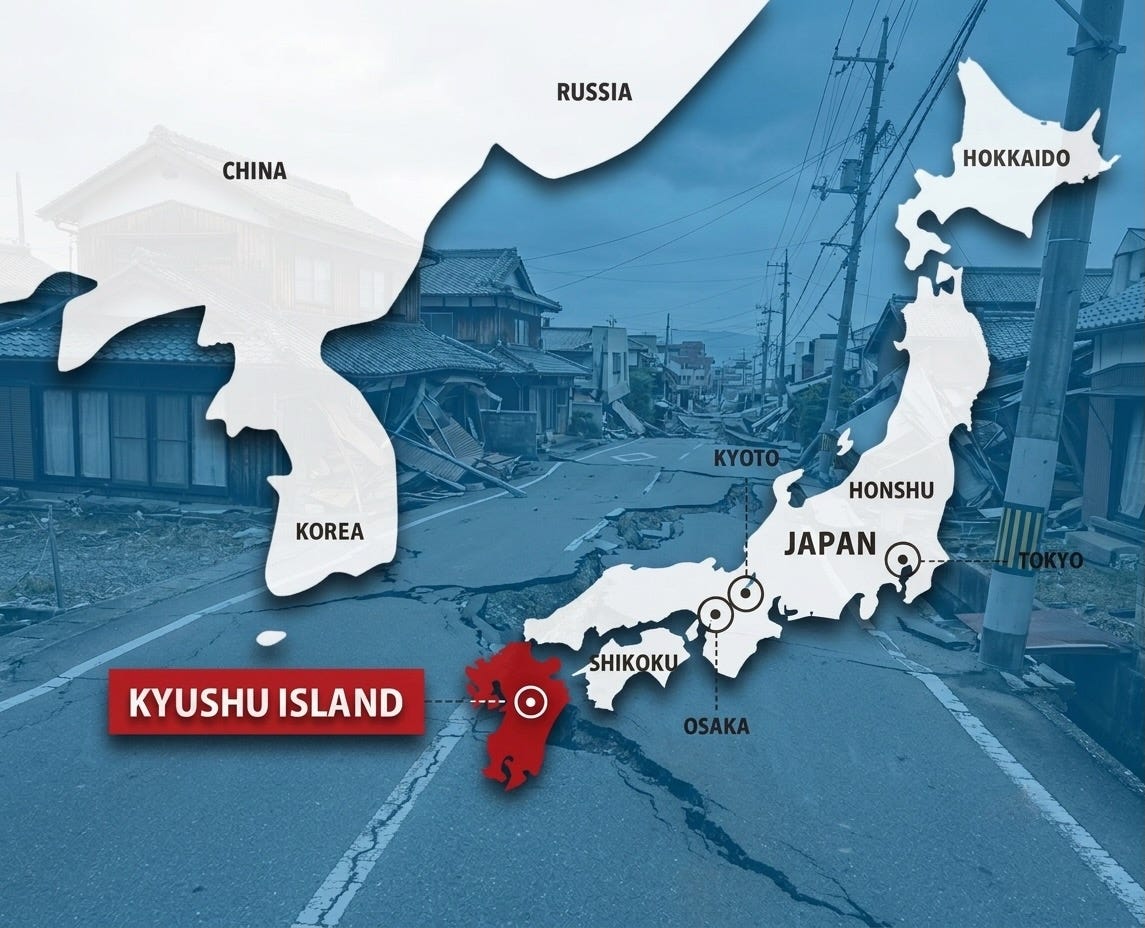
After the devastating 7.1 magnitude earthquake that hit Kumamoto last week, I decided it was time to pour my heart and soul into writing about why you should care about Japan's most underrated island.
Editor’s Note: Last week’s 7.1 magnitude earthquake in Kumamoto was heartbreaking for me. It struck almost exactly 10 years after the last one, and it feels like a shadow of destruction now hangs over Kyushu. That’s why I decided to rewrite this piece.
Kyushu is as “real Japan” as it gets! The nature here is something else. The food, I’d put it above anything I’ve eaten in Tokyo, and the people here are so much warmer. After ten days traveling around Kyushu, I feel like tourists who stick to the Tokyo-Osaka-Kyoto triangle aren’t really visiting Japan. They’re just tour-bus tourists without the bus.
The island is often called Japan’s forgotten island, and it’s easy to see why. Only about 13% of foreign visitors enter through Kyushu, and its population is shrinking by 0.7% a year. Many say the recent 7.1 quake has cast another shadow over an “already dying island”…
Born in Kumamoto, I know firsthand how resilient Kyushu is, and I’m eager to share my thoughts what will make or break the island’s future. And I’ll throw in some photos from me and my wife’s honeymoon for you to enjoy!
So let’s go through the island properly, starting with its crown jewel:
Fukuoka: Kyushu’s Shining Star
Population: 1.77 million.
Population Trend: Japan’s fastest-growing major city at 1.64% annually.
Economic Vitality: Highest business startup rate in Japan at 6.3%.
Famous Draw: Famous for Hakata ramen and open-air food stalls.
Fukuoka City, the largest city in Kyushu, is one of the few growing cities in all of Japan!
One reason for Fukuoka City’s success is its high quality of life: The airport is just 10 minutes from the city center. Public transportation, including subways, trains, and buses, is also very well-developed.
Fukuoka City actively promotes itself as Kyushu’s gateway to Asia, and it truly lives up to that title. Apart from Tokyo, Osaka and of course Kyoto, I’ve never seen more tourists, and there’s definitely things for them to do! The city feels very young, filled to the brim with hip cafes, stores, bars, and nightclubs at every street corner. Fukuoka is a vibe that you need to visit!
Employment, startups, and more
Fukuoka Prefecture accounts for approximately 3.4% of Japan’s GDP, which is nowhere near the Japan’s big boy cities, but how the city is growing is impressive.
In 2012, Fukuoka began calling itself “Startup City Fukuoka,” and in 2014, it was designated a National Strategic Special Zone for Startups and Job Creation. Doesn’t exactly roll of the tongue, but the policies that followed have been successful: Issuance of startup visas, tax incentives for entrepreneurs, the establishment of one-stop support centers called Startup Cafes, and perhaps the biggest one, the large-scale Tenjin Big Bang Project, which relaxed building height restrictions and transformed the city’s landscape.
As a proof of success new tech companies, especially startups, often prefer to establish their bases in Fukuoka, and a vibrant technology scene attracting young talent has emerged.
Tourism, and of course, ramen, are also excellent
In 2019, the number of foreign tourists visiting Fukuoka reached a record high, and the total number of foreign tourists in Kyushu as a whole increased 4.2 times in just 10 years.
The city has managed to claim Japan’s most popular dish, ramen. The whole city literary smells of Hakata ramen!
But fret not ramen haters, the city is almost as famous as Osaka for its vibrant street food scenes. And if your on a diet, the city also sports the most shopping malls in all of Kyushu.
After everything collapsed due to the COVID-19 pandemic, Fukuoka’s recovery was surprisingly rapid. By the end of 2022, the number of foreign tourists had recovered to about 90% of the 2019 level, and now there are more tourists than ever before.
Domestically, Fukuoka consistently ranks high in “most desirable cities to live in” surveys. The cost of living is far lower than in Tokyo or Osaka, urban life is truly comfortable, and beaches and nature are inside the city limits. A significant U-turn phenomenon is occurring, with Japanese people who moved to Tokyo a few years ago returning to Fukuoka in search of a better work-life balance.
If you’re looking for truly Japanese city that is still full of job opportunities and rents that are so cheap you’d blush, Fukuoka is the place.
BEWARE though: While real estate prices remain far lower than in Tokyo, they are rapidly rising.
Kumamoto: Kyushu’s Silicone Island
Population: 972,195.
Population Trend: Growing at 4.68% annually.
Economic Vitality: Transforming into a global semiconductor hub with new TSMC factories driving nearby land prices up over 30%.
Famous Draw: Famous for Kumamoto Castle and regional dishes like basashi.
Just when things seemed stable, everything changed overnight.
Kumamoto City’s population was projected to shrink, placing it in the same sad category as so many disappearing Japanese cities.
Then, TSMC arrived.
In 2021, Taiwan’s semiconductor giant TSMC announced it would build a large-scale new factory in Kumamoto Prefecture as a joint venture with Sony and Toyota. The first factory, called JASM, officially began operations in February 2024 and entered mass production by the end of that year. Over night, hundreds of acres of farmland were converted to hotels, apartments, houses and entertainment venues to cater the immigrating well-paid workforce.
But why Kumamoto?
You see, Kyushu was once known as “Silicon Island,” at one point accounted for approximately 40% of Japan’s IC chip production. When TSMC considered establishing a presence, Kumamoto was the first prefecture to jump on the opportunity with generous incentives. Subsidies of up to 150 million yen were provided to foreign companies, and up to 500 million yen to domestic companies wishing to relocate their headquarters.
Safe to say, it has paid of handsomely with economic forecasts predicting that TSMC’s presence will generate approximately 20.77 trillion yen in economic benefits for Kumamoto Prefecture by 2030, creating around 3,400 high-tech jobs and attracting over 100 supplier companies. Furthermore, a second factory for manufacturing more advanced 6-nanometer chips is already under construction.
However, not everything is going smoothly. They are facing a serious labor shortage. It is estimated that approximately 1,000 new semiconductor workers will be needed annually in Kyushu. Traffic congestion around the new industrial park is worsening, and housing shortages are severe. Luckily for TSMC, Japan excels in construction, and I am sure Kumamoto will do everything they can to ease the housing situation.
Kumamon and culture
After last week’s horrific 7.1 magnitude earthquake, I noticed that even during these dark times, people wanted to proudly show of their Kumamoto heritage. Even on the news, volunteers were wearing Japan’s most famous mascot, Kumamon, on their masks while clearing rubble.
Cultural heritage is also a major support. Kumamoto Castle, despite being seriously damaged both in this and the previous massive earthquake, still maintains its breathtaking beauty. Mount Aso, a massive caldera registered as a UNESCO Global Geopark, is truly a place like another world. The Amakusa Islands are incredibly beautiful.
Kumamoto city center is also very charming. Having partly grown up there, I fondly remember the cute local sweets shops mixed with modern shopping malls, and in true Kyushu fashion; the thousands of izakayas peppered around town ready to serve Japan’s thirstiest souls. The excellent Shinkansen station connecting the city with the rest of Kyushu, and a decently sized airport makes it the second hub of the island.
It’s hard to believe now, but Kumamoto Prefecture used to be one of the poorest cities in Kyushu. However, thanks to smart policies by the city and TSMC’s investment, the entire economy is shifting from agriculture and small-scale manufacturing to high-tech industries. Kumamoto Prefecture is betting heavily on the future of high technology. And frankly, it’s a very promising bet.
Kagoshima: A volcano, rockets, and empty houses
Population: 579,000.
Population Trend: Steadily shrinking amid nationwide rural depopulation.
Economic Vitality: Food manufacturing drives the economy at 53% of industrial output.
Famous Draw: Famous for the active Sakurajima volcano and Kurobuta pork.
Standing at the former residence of Saigo Takamori, I felt surrounded by perhaps Japan’s most interesting bit of history. It’s no exaggeration to say that this man created modern Japan, yet his house stands silently, almost as if forgotten in a city that is slowly disappearing.
Kagoshima is located at the southern tip of Kyushu, and it’s a beautiful. Watching the sunrise from the hotel’s hot spring, Sakurajima volcano erupts into the clear blue sky, its small plumes of smoke rising, a sight I will never forget.
However, the city itself is not in good shape. Kagoshima’s population is projected to shrink to 576,000 in 2026 from 579,000 in 2025, an ongoing trend in a city that’s experience population decrease of approximately 1.1% since 2015. Kagoshima Prefecture’s birth rate is actually slightly above the national average, which offers some relief, but it’s not enough to improve the situation.
Bright signs for the regional economy
The economic base is quite diverse. Agriculture is thriving, producing green tea, sweet potatoes, and the famous Kurobuta pork (may I say the world’s tastiest). Furthermore, there is a noticeable commitment to renewable energy. In 2013, a massive 70-megawatt solar power plant was constructed in Kagoshima Bay, one of Japan’s first hyper scale solar projects.
The opening of the Kyushu Shinkansen in 2011 reduced travel time to Fukuoka to approximately 1 hour and 20 minutes. This undoubtedly led to an increase in tourists and business travelers, and new developments such as AMU Plaza can be seen around the station. However, this is a double-edged sword. Easier access also means that it’s easier for local residents to pack their bags and leave.
Kagoshima Prefecture is also home to the Tanegashima Space Center, one of Japan’s major rocket launch sites, and is truly one of the most photogenic launch sites in the world.
Tourism is life
Kagoshima Prefecture relies heavily on tourism. While Sakurajima is the main attraction, we mustn’t forget Yakushima, a UNESCO World Heritage Site. Yakushima boasts the ancient cedar forest that served as the setting for the Ghibli film Princess Mononoke.
Walking through Yakushima’s forests, You’ll feel an indescribable sense of ancient history, with moss, mist, and trees that have survived for thousands of years.
However, the problem begins here. Tourism jobs are highly seasonal and tend to have low wages. Even though it’s Kagoshima’s fastest growing industry, it alone is insufficient to prevent the exodus of young people.
While the quality of life is high, the job market is quite limited. Frankly speaking, outside of tourism, agriculture and some niche manufacturing, there is a stark lack of opportunities.
Nagasaki: History, sorrow, and struggle
Population: 392,281.
Population Trend: Steadily shrinking due to rapid aging and youth outmigration.
Economic Vitality: Driven by a historic shipbuilding sector and Japan’s second-largest fishing catch.
Famous Draw: Famous for the Nagasaki Peace Park and Castella cake.
Nagasaki’s situation is perhaps the most severe among Kyushu’s major cities.
The city’s population is estimated to be approximately 379,400 as of July 2026, a continued decrease from the roughly 409,000 recorded in 2020. This represents one of the most rapid population declines in Japan, marked by a decrease of nearly 12% between 2015 and 2026. This decline comes from rapid aging, an extremely low birth rate, and decades of youth exodus. In fact, the population peaked around 1970, so it’s not exactly a new trend.
However, Nagasaki used to be one of Japan’s richest cities. It was the birthplace of Japan’s Industrial Revolution. It was a center of heavy industry, home to Mitsubishi Heavy Industries’ shipyards and coal mines. However, shipbuilding orders gradually declined, and coal mines closed.
Because the city is built on steep hills, it boasts breathtakingly beautiful scenery, but there is little flat land suitable for large-scale factories. Therefore, Nagasaki has desperately attempted to shift to other sectors. High-tech research, particularly Nagasaki University’s strong reputation in tropical medicine and renewable energy, has become a major focus. Software outsourcing and call centers are also examples. Offshore wind power and aquaculture offer hope for the future, but frankly, they haven’t filled the huge void left by traditional industries.
A incredibly rich history
From a cultural perspective, Nagasaki is a treasure trove. For centuries, Nagasaki was Japan’s only window to the West, and perhaps what its most known for, it suffered the tragedy of the second atomic bombing.
The sights here hold deep significance in people’s hearts. These include Peace Park, the Atomic Bomb Museum, Glover Gardens with its European-style mansions, and hidden Christian sites registered as a UNESCO World Heritage Site. Huis Ten Bosch, a Dutch-themed amusement park three times the size of Disney Land Japan, is also a major attraction. A new Hong Kong-based owner took over in 2022 and is undertaking a complete renovation of the park.
According to a report by the Nagasaki Prefectural Tourism Promotion Bureau, the number of tourists from outside the prefecture in March 2026 is projected to increase by 10% compared to the same month of the previous year, indicating at least a certain degree of positive progress.
The West Kyushu Shinkansen opened in September 2022, connecting Nagasaki and Takeo. While a transfer is still required to travel to Fukuoka, the journey time has been reduced by approximately 30 minutes.However, a concern is that this Shinkansen might not encourage population influx into Nagasaki, but rather cause commuters to leave…
Furthermore, there was a plan to attract a casino. Nagasaki City poured all its resources into a $3.8 billion project including a casino, constructing an integrated resort (IR) at Huis Ten Bosch, promoting it as a way to transform the local economy. However, at the end of 2023, the national government rejected the plan due to financial concerns. This was a huge blow to the already cash strapped region.
Attempting to fight back
Nagasaki City is currently offering small subsidies to attract remote workers and people returning home for the holidays. The Goto Islands have achieved some success in attracting IT professionals by providing allowances and fiber optic internet access.
With the decline in the child population, school consolidation is also progressing. In 2018, Iki City launched the SDGs Future City Project in collaboration with Fuji Xerox to establish local telework centers, allowing kids from communities too small for schools to get top-class education through technology.
Furthermore, Nagasaki Stadium City, a 100 billion yen sports, entertainment, and business complex, opened in October 2024. This can truly be called a big gamble for the future 🥁.
Nagasaki has soul, a true history, and a breathtaking beauty rarely seen elsewhere. If you want to really understand Japan, it’s a place you absolutely must visit. However, from the perspective of residence and investment, the headwinds are serious, and unless a large-scale new industry emerges, the situation is unlikely to improve.
Miyazaki: A small success story
Miyazaki, a tiny laid back town famous for its pristine beaches, amazing golf courses, and the worlds most expensive mango, has maintained almost perfect stability. With a positive growth of only 0.05% from 2015 to 2020, its population is approximately 401,000. In addition to its role as an administrative center, it functions as a resort and retirement home in Japan’s warm southern region.
I took a morning jog along the river in Miyazaki. Palm trees lined the path, a pleasant breeze blew, and a bunch of surfer dudes were getting ready to jump in the ocean. If I didn’t need a job, I could truly see myself live there.
Miyazaki shows that you don’t need a miracle to be sustainable. Just be a nice place for tourists and retirees and you might just prove the world that decline is not an inevitable force.
The real crisis is in small cities
Small regional cities throughout Kyushu are experiencing a frightening rate of population outflow. Makurazaki City in Kagoshima Prefecture lost 9% of its population in just five years. Misato City in Kumamoto Prefecture has shrunk to one-third of its size in 1947. Some of these areas are literally on the brink of extinction.
The government is implementing various measures, such as hometown taxes, regional revitalization subsidies, and incentives for relocating from distant areas, but their population decline keeps accelerating.
What separates Kyushu’s winners and losers?
The city mayor is extremely important.
Fukuoka, led by Mayor Soichiro Takashima, had a clear plan when he took office, driving massive growth through strategic deregulation and a relentless focus on becoming a startup hub. Kumamoto, driven by Mayor Kazufumi Onishi, actively attracted TSMC and succeeded. Compare these leaders to “failed cities” like Nagasaki and Kagoshima, which failed to explore methods for urban regeneration and steadily declined. Instead they clung to traditional tourism and legacy industries, ultimately missing out on modern corporate investments and young talent.
2. Employment, employment, employment.
People move where there are jobs. It’s that simple. Fukuoka created jobs in new economic sectors. Nagasaki City and Kitakyushu City lost their heavy industrial base and were unable to replace it on a large scale. Universities are also extremely important. Universities supply young talent and research results to the regional economy. Fukuoka, Kumamoto, and Kitakyushu all have major universities.
Roads, railways, and ports.
The Shinkansen supports tourism and business in cities like Kagoshima City and Kumamoto City. Sure, it’s a double edged sword as it also enables people to leave easier, but let’s be honest, a Japanese city will never be successful without a Shinkansen station. The modern airports and ports of Fukuoka and Kitakyushu are a major advantage for the region’s access to Asia, crucial both for industry and tourism. This is more hygiene than a fix; have it and you can still become a declining city. Don’t have it, and you never had a chance to recover in the first place.
Tourism is a necessary evil
The 4.2-fold increase in foreign tourists visiting Kyushu between 2008 and 2018 significantly revitalized Fukuoka, Nagasaki, Oita, and Kagoshima. Sure, tourism can be a serious distribution to people’s daily life, but let’s not beat around the bush here. Tourists are a necessity in Kyushu, and without them, many regions would collapse entirely. It’s also the simplest thing for Kyushu to promote as the island is full to the brim with incredible natural sights and cuisine that is truly world-class. I can’t think of a better place to spend your honeymoon.
Young people leaving is the biggest problem
An aging populations and an exodus of young people are by far the biggest reasons Kyushu is struggling. Fukuoka, with its relatively young population, is naturally in a favorable position. Nagasaki, with its very high proportion of elderly residents, is facing a negative spiral of rapid aging which leads to less taxes money for young people which leads to a youth exodus. Kyushu’s birth rate is slightly above the national average, providing a small buffer, but currently, population migration patterns are far more important than birth rates.
My prediction of Kyushu’s future:
Fukuoka will continue to lead the way and likely thrive even in the far future. Kumamoto has the potential to gain momentum rapidly if its semiconductor ecosystem grows as expected. Kagoshima and Miyazaki will experience a gradual decline or maintain the status quo if their tourism and local industries remain strong.
Nagasaki and the smaller towns in the provinces will face the most difficult path, and population decline is likely to increase rapidly until they completely collapse, unless there is a dramatic change.
Aging and a declining birthrate are the issues that everyone recognizes here, which is why I think they are slowly figuring out how to at least mitigate it. Already, effective efforts like smart city technologies for elderly care, better access to healthcare, and comprehensive support for families raising children are being successfully implemented. In the future, I think only. cities that can develop these further will thrive.
I hope this peace has convinced you that Kyushu is not a single story. While thriving cities lead the way and have a big change at become world-class metropolises, neighboring towns struggle to redefine their identities. Kyushu is perhaps the most paradoxical place with ancient traditions coexist alongside cutting-edge technology. A “forgotten” island, yet upon closer inspection, it might just hold the keys for Japan’s future.


