
Please note: This article is for informational purposes only and does not constitute investment advice. The mention of specific stocks is not a recommendation to buy or sell any securities. The author may hold positions in the equities discussed. Investing carries inherent risks, and you should always conduct your own due diligence before making any financial decisions.
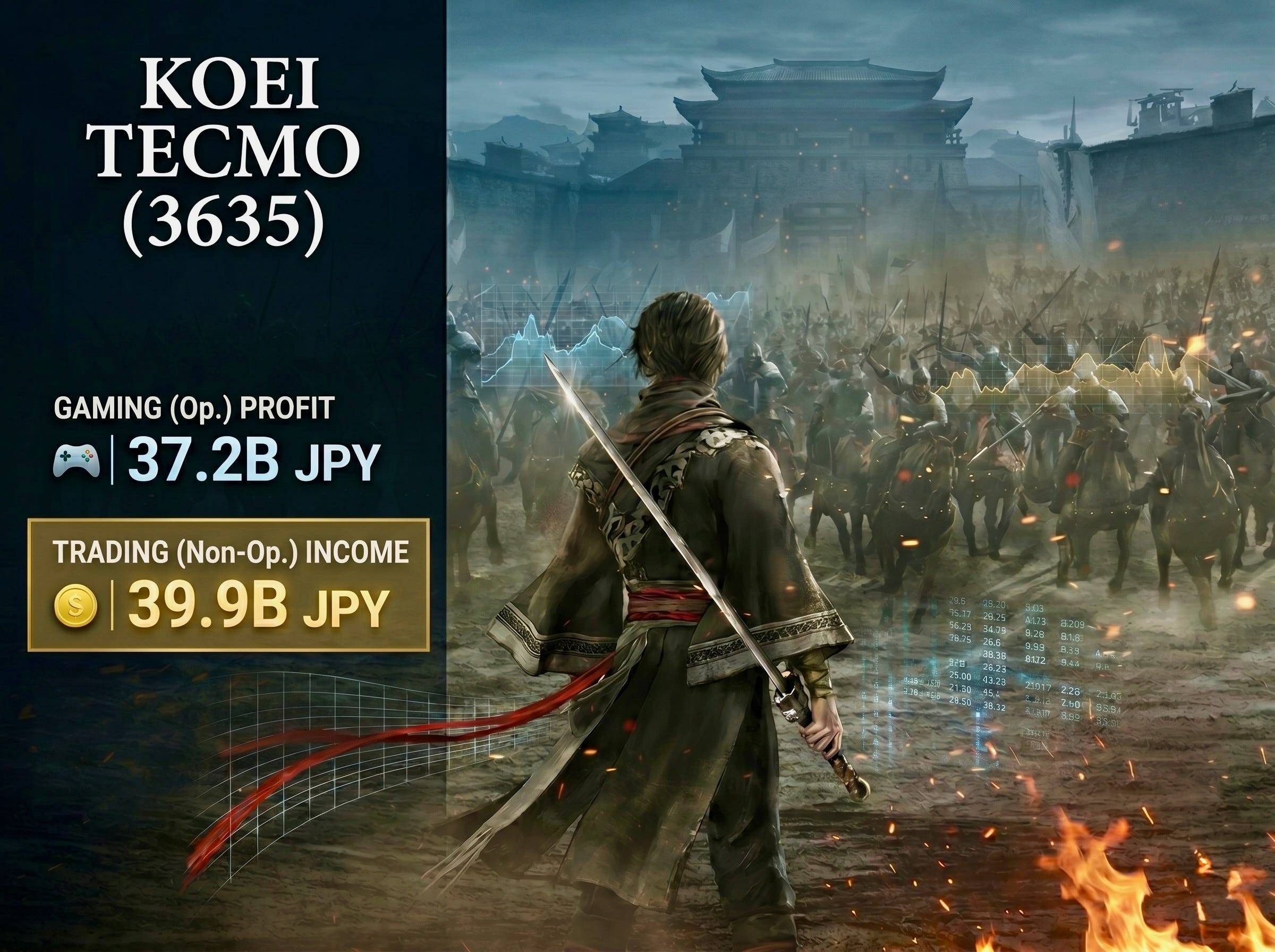
I used my super duper bullet proof value investing screener in LSEG Workspace (the Bloomberg terminal for poorer people đ„Č) to find the most interesting value investing case right now on a quite frothily valued Japanese stock market. The Nikkei 225 index just breached the 65,000 mark for the first time in May 2026, and everyone on the street is losing their collective minds over semiconductor stocks and AI hype.
After a lot of digging, I found a weird anomaly in the screener I first couldnât believe, a gaming company with growing profits, one of the highest margins in the industry, and yet valued at P/E<11x.
On the surface, Koei Tecmo Holdings (3635) make video games about historical warlords hitting thousands of peasants with giant swords. Under the hood, they are a hyper-aggressive hedge fund wrapped in a digital entertainment publisherâs trench coat.
Every analyst covering Koei values the company strictly on software sales and gaming projections. But they completely miss that the company makes more money from massive offshore trades run by its legendary 77-year-old Chairwoman Emeritus than from its entire video game portfolio!
The market is pricing Koei Tecmo as a mediocre software developer, entirely missing the fact that it is the most fascinating corporate structure in Japan right now.
Executive Summary
Rating and Target Price
Rating: Strong Buy
Current Price: 1,531 JPY (as of May 22, 2026)
Target Price: 3,200 JPY
Investment Horizon: 24 to 36 Months
Summary of Investment Thesis
Koei Tecmo Holdings is grossly mispriced by the broader equities market due to a fundamental misunderstanding of its dual-engine business model. The company generates industry-leading operating margins of 42.0% from its core video game entertainment segment. Simultaneously, its non-operating income from aggressive corporate asset management frequently eclipses its actual operating profit. Investors are effectively buying a world-class proprietary trading desk at a discount, while getting a top-tier Japanese gaming studio for absolutely free.
Key Catalysts
The primary catalyst for a multiple rerating is the recent formalization of Koei Tecmo Corporate Finance, a dedicated subsidiary established in early 2025 to house the companyâs investment portfolio. This institutionalizes the wealth management division and prepares the firm for a generational leadership transition. Furthermore, the massive success of their latest collaborative title, Pokemon Pokopia, proves their proprietary game engine remains a highly lucrative licensing asset. Finally, the company must address its low tradable share ratio of 29.9% to meet Tokyo Stock Exchange Prime Market standards by which started in March 2026, which is already forcing massive share buybacks.
Valuation Summary
The stock trades at a trailing P/E ratio of 11.35x, which is criminally undervalued relative to its sector peers. Competitors like Capcom and Square Enix trade at significantly higher multiples of 23.0x and 36.2x respectively, despite possessing inferior balance sheets. The margin of safety is fortified by a robust dividend yield of 4.4% and a massive net cash and securities position that makes up nearly 70% of total assets.
Key Risks
The entire financial strategy hinges on the investment acumen of Chairman Emeritus Keiko Erikawa. Her eventual complete retirement poses an unquantifiable key-person risk to the non-operating income stream. Furthermore, heavy exposure to volatile financial markets introduces severe earnings instability, as demonstrated by the company losing 4.1 billion yen overnight during the Credit Suisse collapse in 2023.
Pillar 1: The Narrative
The origins of Koei Tecmo read less like a standard corporate founding and more like a financial survival thriller. Yoichi Erikawa originally ran his familyâs dye business in Ashikaga, but the enterprise eventually collapsed under severe debt. It was his wife, Keiko Erikawa, who stepped in and utilized her incredibly sharp stock market skills to keep the family afloat during this existential crisis. This early reliance on the financial markets forged a corporate DNA that prioritizes aggressive capital management alongside product development.
To cheer up her husband during this dark period, Keiko purchased a Sharp MZ-80C microcomputer for his birthday in 1978. This machine was astronomically expensive for a struggling family, but it served as the ultimate catalyst for their future empire. Yoichi taught himself programming in the evenings and eventually developed the legendary historical simulation game Nobunagaâs Ambition.
While Yoichi focused on creating deep, complex strategy games, Keiko identified massive untapped demographics in the gaming market. She established an all-female game development group called Ruby Party. This brilliant team created Angelique, effectively inventing the âotomeâ romance game genre and proving that a massive market for female gamers existed.
The Erikawa duo termed their management philosophy âgeneral excellenceâ. They blended creative risk-taking in software development with ruthless financial pragmatism in asset management. Keiko Erikawa earned the nickname âThe Empressâ within the industry due to her terrifyingly effective investment acumen.
She built a corporate investment portfolio that eventually swelled past 120 billion yen, shielding the company through every single downturn in the notoriously cyclical video game market. Instead of letting surplus cash rot in low-yield Japanese bank accounts, she actively traded equities, derivatives, and foreign bonds.
Her success was so profound that she was appointed as an independent director to the board of SoftBank Group in 2021. She became the only woman to sit on the board of Masayoshi Sonâs conglomerate, offering vital supervision and advice based on her legendary track record.
In early 2025, the company underwent a massive generational transition to secure this unique structure for the future. Yoichi Erikawa stepped up to the role of Chairman, while long-standing executive Hisashi Koinuma took over as President and CEO. Keiko Erikawa transitioned to Chairman Emeritus and took the helm of a newly established, wholly-owned subsidiary named Koei Tecmo Corporate Finance.
This new corporate finance arm officially absorbed all investment functions from the legacy gaming division through an absorption-type company split. The move was explicitly designed to strengthen governance related to investments and optimize cash management across the entire conglomerate. It was a formal, legally binding acknowledgment that Koei Tecmo is an asset manager just as much as it is a software developer.
Japanese fans on social media regularly joke that Koei Tecmo is an investment fund disguised as a gaming company. They thank âThe Empressâ for generating the massive budgets required to fund high-quality releases like Dynasty Warriors Origins. They are absolutely right to do so, because her trading desk routinely outperforms the core operating business.
Pillar 2: The Moat
The video game industry is notoriously brutal, resembling the Hollywood movie business where one massive flop can bankrupt an entire studio. Koei Tecmo avoids this trap by maintaining a highly disciplined, proprietary game engine and leaning heavily on lucrative collaborative titles.
The companyâs true competitive advantage lies in its patented âWarriorsâ gameplay formula, developed by their internal Omega Force studio. Instead of competing directly with giants like Nintendo or Square Enix, Koei Tecmo becomes their essential manufacturing partner. They have successfully applied their proprietary hack-and-slash engine to major intellectual properties like Zelda, Fire Emblem, and Persona.
This collaboration strategy drastically lowers research and development risks while guaranteeing a built-in, fanatical consumer base. The recent release of Pokemon Pokopia perfectly illustrates this moat in action. Co-developed with Game Freak, this post-apocalyptic life simulator launched in March 2026 and sold 2.2 million copies in just four days.
When Koei Tecmo does release proprietary titles, they target very specific, loyal niches to ensure high profitability. Nioh 3 launched in February 2026 and quickly sold over one million copies across all platforms. The use of their in-house Katana Engine allows Team Ninja to iterate rapidly without the bloated software licensing costs that plague western developers.
To truly understand this moat, one must compare Koei Tecmo directly against its domestic rivals. Capcom and Square Enix represent the two opposite ends of the Japanese third-party publishing spectrum. The data reveals exactly why Koei Tecmo holds the superior structural position in this industry.
Competitor Comparison: Capcom (9697)
Capcom is undeniably a phenomenal business, boasting thirteen consecutive years of operating profit growth. They have successfully globalized massive franchises like Resident Evil, Street Fighter, and Monster Hunter. Their operating margin hit an absurd 48.5% in the first half of fiscal 2025, driven by a massive shift to high-margin digital downloads.
Capcom's stock has taken a brutal beating, dropping roughly 28-32% over the last year depending on the exact exchange data you pull. However, even after that massive haircut, Capcom is still trading at a P/E of 23x. Furthermore, they do not possess a shadow hedge fund generating billions of yen in non-operating profit to smooth out inevitable software delays.
Competitor Comparison: Square Enix (9684)
If you want to see how to systematically incinerate shareholder capital, look no further than Square Enix. They are currently stumbling through a difficult transition period characterized by bloated development budgets and declining legacy revenues. Their net sales dropped 8.3% in fiscal 2026 due to severe weaknesses in their MMO segment following the Final Fantasy XIV Dawntrail expansion.
While they managed to temporarily increase operating income through drastic cost-cutting, their structural reliance on massive, risky blockbuster titles makes them highly vulnerable. Their management team seems determined to chase passing trends while neglecting the disciplined cost control required in modern game development. They are the exact opposite of Koei Tecmoâs âgeneral excellenceâ philosophy.
The Koei Tecmo Advantage
Koei Tecmo sits comfortably in the middle, avoiding the expensive valuation of Capcom and the structural chaos of Square Enix. The company achieved a 42% operating margin in fiscal 2026, proving their core gaming business is highly efficient. They have a deeply entrenched economic moat built on reliable collaborations, predictable cash flows, and a fan base that eagerly buys every iteration of Dynasty Warriors.
The qualitative moat is ultimately defined by survival capabilities. The portfolio managed by Keiko Erikawa acts as an impenetrable financial fortress. This allows the creative teams at Omega Force and Team Ninja to take calculated risks without fearing corporate insolvency, a luxury no other studio in Japan possesses.
Pillar 3: The Financial Engine
I told you before that this company is a weird amalgamation between a hedge fund and a gaming company. Well, prepare to see the weirdness in action:
My LSEG Workspace screener initially flagged the company due to its bizarre and highly attractive capital structure. According to the extracted dataset, the company has a Net Debt to EBITDA ratio of -2.49x. This indicates a completely unleveraged balance sheet overflowing with highly liquid assets.
A thorough review of the consolidated statement of income for fiscal 2026 reveals the true nature of this financial beast. Net sales rose 6.3% year-over-year to 88.39 billion yen, driven by strong collaborative royalties and new software releases. Operating profit increased a very respectable 15.7% to 37.16 billion yen.
The real shock and awe occurs in the non-operating section of the income statement. Total non-operating income reached a staggering 39.92 billion yen in fiscal 2026.
Let me repeat that: The company generated more income from trading stocks and derivatives than it did from selling video games.
Income Statement & Portfolio Data (Fiscal Year 2026)
Net Sales: 88,393 million JPY
Gross Profit: 57,062 million JPY
Operating Profit: 37,168 million JPY
Non-Operating Income: 39,923 million JPY
Non-Operating Expenses: 20,091 million JPY
Ordinary Profit: 57,000 million JPY
Profit Attributable to Owners: 42,830 million JPY
This massive non-operating windfall was primarily driven by an 18.64 billion yen gain on the sale of investment securities. They also booked 5.37 billion yen in derivative valuation gains and 12.26 billion yen in pure interest income.
So, what exactly is the Empress buying with this massive war chest? The infuriating reality for analysts is that the exact daily composition of her trading book is a closely guarded corporate secret. Under Japanese financial disclosure regulations, companies are only required to explicitly itemize âspecified investment equity securitiesâ held for strategic business alliances.
Assets held âfor purely investment purposesâ or short-term trading do not require full public itemization, rendering her multi-billion dollar portfolio a literal black box to outsiders. We know her stated strategy prioritizes continuity, flexibility, and soundness through active management of domestic and foreign equities and bonds. She leverages her massive industry network, highlighted by her personal seven million dollar stake in SoftBank, to pick individual winners.
However, the lack of line-by-line portfolio transparency is exactly why Wall Street ignores the asset management division entirely. As a value investor, I accept this opacity because her historical success and reliability are verifiable through the actual income statements. You do not need to know the specific holdings when the long-term track record of net non-operating income is this bulletproof.
Let us look at the historical data for the trading deskâs net non-operating income and expenses. Since fiscal 2013, the Empress has only recorded a net loss in a single year, which was a negligible 2.6 billion yen drop in 2019. In stark contrast, her net gains have compounded aggressively over the last decade.
Fiscal 2013 to 2015: Averaged roughly 6.4 billion JPY in net non-operating income annually.
Fiscal 2021 to 2022: Surged to over 17.2 billion JPY and 17.8 billion JPY respectively.
Fiscal 2024 to 2025: Logged 14.1 billion JPY and 19.8 billion JPY in net gains.
Fiscal 2026: Smashed all records with 39.9 billion JPY in gross non-operating income.
This legendary ability to compound surplus cash creates a permanent financial safety net. It ensures that the company maintains ample available funds to proactively pursue massive software development projects, regardless of short-term shifts in business results. Her creative teams can take massive developmental risks without ever worrying about bankrupting the studio.
Furthermore, this financial consistency translates directly into massive shareholder returns. The company has successfully maintained an aggressive 50% dividend payout ratio for 15 consecutive years. Total dividend payouts have skyrocketed from a modest 1.16 billion yen in 2009 to a staggering 18.9 billion yen by 2024.
The non-operating expenses also jumped significantly to 20.09 billion yen, heavily driven by 17.83 billion yen in losses on the sale of investment securities. This high volume of realized gains and losses indicates an extremely active trading desk that is constantly turning over the portfolio to capture market inefficiencies. The net result of this financial engineering was an ordinary profit of 57.0 billion yen, smashing previous corporate records.
Moving to the balance sheet, the financial fortification becomes even more apparent. Total assets ballooned to 313.66 billion yen by the end of March 2026, up from 209.82 billion the previous year. This massive expansion was heavily concentrated in highly liquid current assets and strategic investment holdings.
Balance Sheet Data (March 31, 2026)
Cash and Deposits: 61,275 million JPY
Current Securities: 53,882 million JPY
Total Current Assets: 139,608 million JPY
Property, Plant & Equipment: 59,216 million JPY
Investment Securities (Non-current): 101,687 million JPY
Total Assets: 313,662 million JPY
The combined total of cash, current securities, and non-current investment securities equals roughly 216.8 billion yen. This means that nearly 70% of the companyâs total asset base consists of pure financial ammunition. Very few publicly traded entities outside of the banking sector operate with this level of capital density.
The equity ratio remains exceptionally high at 86.7%, indicating almost zero reliance on external debt financing. Retained earnings swelled to 207.3 billion yen, reflecting decades of disciplined capital accumulation. This financial engine does not just support the gaming studio; it actively subsidizes it, allowing for unmatched creative freedom.
When you buy a share of Koei Tecmo, you are buying a slice of this massive liquidity pool. The gaming revenues simply provide fresh capital for Keiko Erikawaâs trading desk to deploy into the global markets. It is a brilliant, self-sustaining ecosystem that the broader market completely fails to comprehend.
Pillar 4: The Margin of Safety
Koei Tecmo Holdings currently trades at a trailing P/E ratio of 11.35x. To put this in perspective, the broader Japanese market index averages considerably higher in the frothy 2026 macroeconomic environment. Buying a highly profitable technology and entertainment company at an 11x multiple is a structural anomaly that rarely lasts.
The enterprise value to EBIT ratio sits at a very comfortable 11.44x. This metric is absolutely crucial because it accounts for the massive net cash and securities position resting on the balance sheet. When a buyer acquires a share of Koei Tecmo, they are essentially buying a massive pile of cash and a high-yield investment portfolio, getting the actual video game development studio for pennies on the dollar.
Competitor Valuation Comparison
Koei Tecmo Holdings (3635.T): P/E Ratio of 11.35x, Operating Margin of 42.0%, P/B Ratio of 1.97x.
Capcom Co Ltd (9697.T): P/E Ratio of 23.0x, Operating Margin of 48.5%, P/B Ratio of roughly 4.1x.
Square Enix Holdings (9684.T): P/E Ratio of 36.2x, Operating Margin of 18.4%, P/B Ratio of 2.86x.
The comparative data illustrates the sheer absurdity of current market pricing. Square Enix is trading at a staggering 36.2x earnings multiple despite suffering from declining top-line revenues and a mediocre 18.4% operating margin. Capcom is appropriately priced for its high performance, but offers absolutely no margin of safety for value investors at 23x earnings.
Koei Tecmoâs Price to Book ratio of 1.97x is modest considering the book value is primarily composed of highly liquid securities. It is not inflated by depreciating physical assets or questionable goodwill from terrible acquisitions. The Piotroski F-Score of 6 confirms the fundamental health of the business operations, indicating strong cash flow generation and solid profitability trends.
Furthermore, the 10-year historical earnings growth rate of 14.7% proves this is not a stagnant value trap. The final pillar of the margin of safety is the aggressive capital return program championed by management. The board targets a consolidated payout ratio of 50%, reflecting a deep commitment to minority shareholders.
For the fiscal year ending March 2026, the company hiked the year-end dividend to 66 yen per share. Based on the May 2026 trading price of approximately 1,531 yen, this translates to a dividend yield of roughly 4.3-4.4%. Getting paid a 4.4% yield to hold a fortress balance sheet in an inflationary Japanese economy is a highly attractive proposition.
Let us do some back-of-the-napkin math to calculate intrinsic value. The current market capitalization is roughly 506 billion yen. If we strip out the 216 billion yen in pure cash and investment securities, the market is valuing the core gaming business at just 290 billion yen.
With the core business generating over 37 billion yen in operating profit, you are paying less than 8 times operating profit for a studio that creates global hit titles. The intrinsic value of the business, when combining the discounted cash flows of the gaming pipeline with the net asset value of the investment portfolio, is significantly higher than the current trading price.
Pillar 5: The Inversion
Charlie Munger famously advised investors to âinvert, always invertâ to uncover the hidden mechanisms that could destroy an investment thesis.
The most glaring vulnerability is the extreme key-person risk associated with Keiko Erikawa. Born in 1949, the âEmpressâ is 77 years old as of 2026. While the establishment of Koei Tecmo Corporate Finance aims to institutionalize her trading strategies, it is impossible to perfectly replicate her legendary gut instincts and market timing.
When she eventually steps away entirely, the non-operating income engine could easily stall or misfire. A corporate finance team of salarymen will never manage a portfolio with the same ruthless, entrepreneurial edge as the woman who built it from scratch. This leadership transition is the single biggest unknown hanging over the stock.
The other major risk involves exposure to severe macroeconomic shocks and volatile financial instruments. The companyâs willingness to chase yield in complex offshore markets has resulted in significant collateral damage before. In March 2023, Koei Tecmo lost 4.1 billion yen overnight when the Swiss government orchestrated the UBS takeover of Credit Suisse, wiping out all Additional Tier 1 (AT1) bondholders.
While the company absorbed the AT1 loss effortlessly thanks to its massive equity base, it highlights the danger of operating a proprietary trading desk with shareholder capital. If the Nikkei 225 index experiences a severe correction from its current 65,000 peak, the investment portfolio will take a heavy beating.
A massive mark-to-market write-down on securities would completely obliterate the non-operating profit line, making the headline earnings look catastrophic for retail investors.
Final Verdict: The KonichiValue Score
Despite the genuine risks associated with aggressive asset management and generational transition, the fundamental math is entirely too compelling to ignore. The market is pricing this company as if the massive investment portfolio has zero tangible value, entirely dismissing billions of yen in highly liquid assets.
The creation of Koei Tecmo Corporate Finance shows a proactive, intelligent approach to institutionalizing the wealth management division. The robust 4.4% dividend yield ensures that investors are paid handsomely while waiting for the broader market to wake up to the valuation discrepancy. The downside is heavily protected by the cash hoard, making a permanent impairment of capital highly unlikely even in a severe recession.
KonichiValue Score: Strong Buy.
The analysis concludes that Koei Tecmo (3635) is the ultimate contrarian play in a severely overvalued Japanese equity market. It is a remarkably rare opportunity to purchase an elite digital entertainment studio attached to a world-class family office at a steep discount. Investors should accumulate shares aggressively before the institutional market realizes this video game company is actually a heavily armed financial institution.


