


Disclaimer: This report is for informational purposes only and does not constitute financial advice. All investments involve risk, including the loss of principal. I, Rei Saito, may hold positions in any securities mentioned.
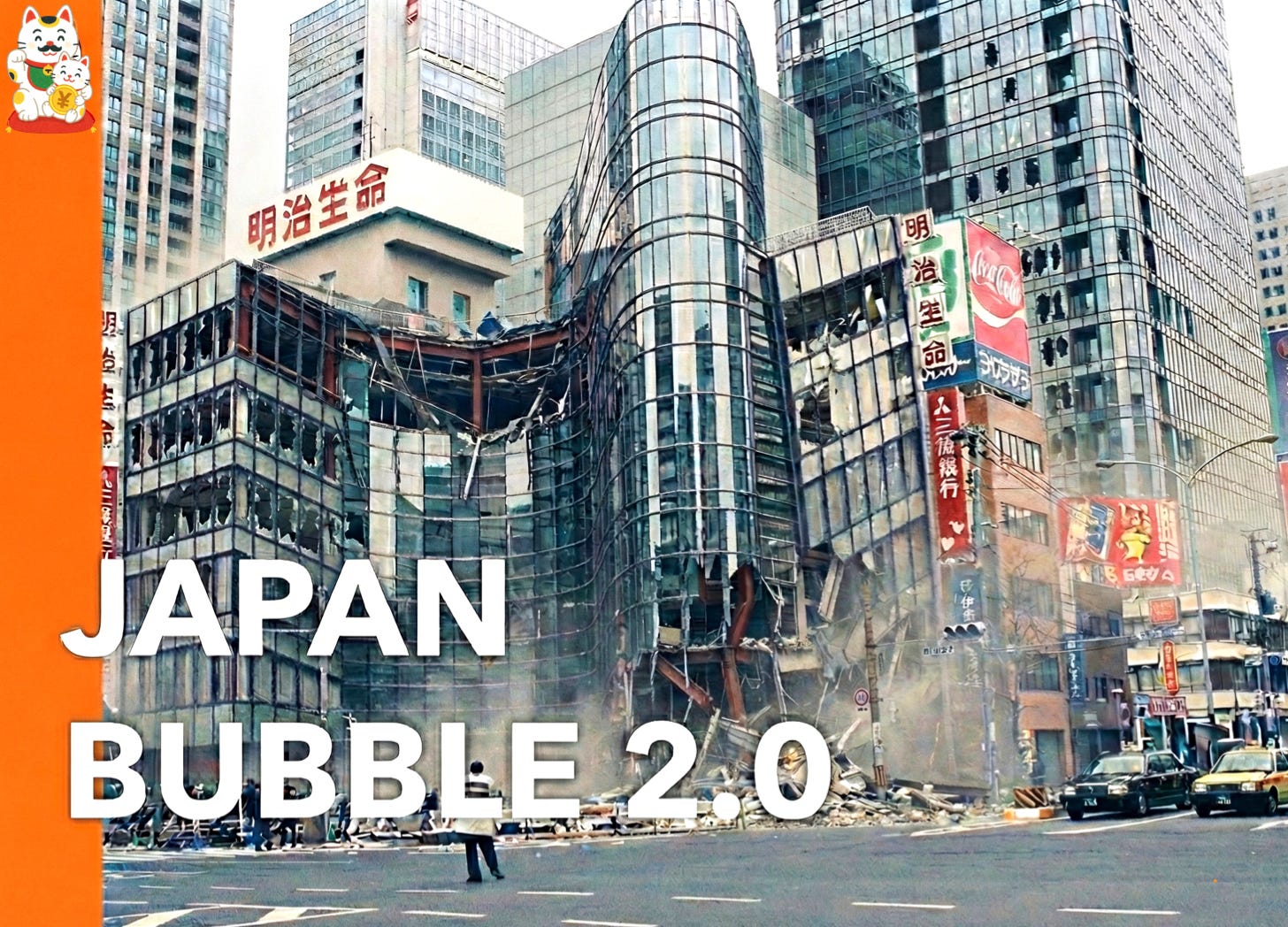
Is this a bubble?
With the Nikkei 225 closing at 53,847 and the TOPIX standing at 3,613, the ghosts of 1989 have returned to haunt Japan.
Recently, the Japanese stock market has gone hyperbolic around the hype around Prime Minister Sanae Takaichi’s “Sanaenomics,” the frenzy in semiconductor stocks, and the sheer thrill that ”Japan might be back!”
The temptation to declare the market too expensive and hoard cash is strong. After all, the psychological barrier of 50,000 has been breached, evoking memories of the asset bubble of 1989 where the Imperial Palace grounds were rumored to be worth more than California.
However, in this article, I argue that the “Bubble 2.0” narrative is fundamentally flawed. I think we are witnessing a rational re-rating driven by the end of deflation, structural corporate reform, and a geopolitical realignment that favors Japan. Unlike 1989, when investors paid 60 times earnings for 1% yields, today’s market offers a positive equity risk premium and balance sheets loaded with cash.
The Ghost of 1989
To understand where we are, we must first exorcise the ghost that haunts every conversation about Japanese equities: the 1989 bubble.
In 1989, the Nikkei 225 peaked at 38,915. At that moment, the market was trading at a Price-to-Earnings (P/E) ratio of over 60x. The earnings yield was less than 2%, while the risk-free rate (10-year JGB) was hovering around 6-7%. Investors were essentially paying for the privilege of losing money relative to bonds.
Fast forward to January 2026. The Nikkei is at 53,847. The index level is higher, yes, but the valuation multiple has collapsed. The forward P/E of the Nikkei is approximately 23.9x, and more importantly, the broader TOPIX index trades at a forward P/E of just 17.1x. We have seen a massive compression in multiples over the last 36 years, even as earnings per share (EPS) have compounded.
Key Comparison: The Tale of Two Peaks (1989 vs. 2026)
Index Level (Nikkei 225):
1989 Bubble Peak: ~38,915
Jan 2026: 53,847 (+38% higher)
Valuation (Forward P/E):
1989 Bubble Peak: ~60x - 70x
Jan 2026: 23.9x (Nikkei) / 17.1x (TOPIX) (Valuations have compressed by ~65%)
Cost of Capital (10Y JGB Yield):
1989 Bubble Peak: ~6.0%
Jan 2026: ~1.1% (Capital is significantly cheaper)
Equity Risk Premium:
1989 Bubble Peak: Negative (-4.4%)
Jan 2026: Positive (+4.7%) (The signal has inverted; you are paid to take risk)
The crucial insight here is the Equity Risk Premium (ERP). In 1989, the bond market offered a risk-free 6%, while stocks offered a volatile 1.6% earnings yield. It was irrational to hold stocks. Today, the 10-year JGB offers ~1.1%, while the TOPIX offers an earnings yield of roughly 5.85%. Investors are being paid a premium of nearly 475 basis points to take equity risk. This is a signal of deep, persistent skepticism that has yet to be fully priced out.
The CAPE Ratio Perspective
Robert Shiller’s Cyclically Adjusted Price-to-Earnings (CAPE) ratio provides another layer of comfort. In the late 1980s, Japan’s CAPE ratio reached astronomical levels, nearing 100x, the highest valuation of any equity market in history. Today, the CAPE for Japan sits in the low-to-mid 20s, significantly below the US market, which is now around a CAPE of 40x.
The “intrinsic value” of a market is ultimately the present value of its future cash flows. In 1989, the market was pricing in growth rates that were physically impossible to achieve. In 2026, the market is pricing in modest growth, despite a backdrop of massive fiscal stimulus and corporate reform.
Sanaenomics and the End of Deflation
The second pillar of my thesis is macroeconomic. The inauguration of Prime Minister Sanae Takaichi has introduced a regime change that I believe the market has only partially discounted.
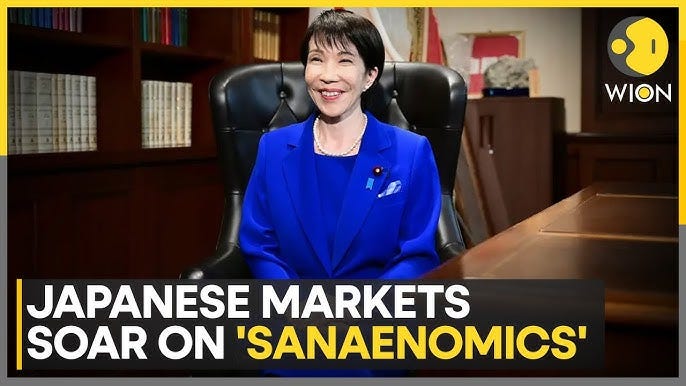
Sanaenomics is frequently compared to Abenomics, but as someone analyzing the legislative text, I see distinct differences. Abenomics was about defeating deflation through monetary velocity. Sanaenomics is about crisis management investment and strategic self-sufficiency. It is a wartime economy mindset applied to peacetime industrial policy.
I might not be a fan of the frivolous spending of Sanae Takaichi, but there is no denying that it is good for the stock market.
The ¥21.3 trillion ($136 billion) stimulus package approved in late 2025 is not a scattershot cash handout. It is highly targeted:
Strategic Growth Investment (¥7.2 trillion): This capital is directed squarely at the commanding heights of the modern economy: AI, Semiconductors, and Defense. By subsidizing the capital expenditures (Capex) of major industrial firms, the government is effectively lowering their cost of equity and increasing their Return on Invested Capital (ROIC).
Household Support (¥11.7 trillion): Sanaenomics addresses consumption with direct energy subsidies and cash handouts (¥20,000 per child). This is critical because it puts a floor under consumption during the transition to an inflationary environment.
For the value investor, this fiscal policy acts as a put option on the economy. The government has signaled it will not allow nominal GDP growth to stall. The Bank of Japan’s upgrade of FY2026 GDP growth to 1.0% is a direct result of this spending.
The End of Deflationary Psychology
For thirty years, cash was king in Japan because goods became cheaper tomorrow. That era is dead. Inflation is now sticky above 2%. The wage negotiations (Shunto) have resulted in hikes of over 5%. This “wage-price spiral” is actually the salvation of the Japanese equity market.
Why? Because inflation destroys the value of the massive cash piles held by Japanese corporations.
The Hoarding Penalty: In a deflationary world, holding cash is an investment, so Japanese companies might have been seen as too conservative for hoarding cash, but it was actually a good strategy. In a 2% inflation world, a company with 40% of its assets in cash (a common profile in the Standard Market) is destroying shareholder value by 2% annually in real terms.
The Behavioral Shift: Inflation forces management to do something with the cash, invest it (Capex) or return it (dividends/buybacks). We are seeing this shift in real-time.
Corporate Governance: The Revolution is Real
If macroeconomics provides the fuel, corporate governance is the engine. The change in tone over the last 24 months is nothing short of revolutionary. The days of polite nods and inaction are over. The Tokyo Stock Exchange (TSE) and the Financial Services Agency (FSA) have fundamentally altered the incentives.


The “Name and Shame” Regime
In March 2023, the Tokyo Stock Exchange released directives on how companies should improve their valuations by providing Price-to-Book (P/B) improvement plans.
Foreign observers who don’t understand Japan dismissed the TSE’s Cost of Capital Directive as there was no legal ramifications.
What they don’t understand is that in Japan, the threat of being named and shamed is more powerful than any punishment...
The exchange proved this by publishing a list of compliant companies, effectively isolating those who hadn’t disclosed P/B improvement plans.
By late 2025, over 90% of Prime Market companies had fallen in line.
The Unwinding of Cross-Shareholdings (Mochiai)

Cross-shareholding has been the poison pill of Japanese capitalism, companies holding shares in their clients and banks to cement relationships and insulate management.
The Catalyst: The FSA has pressured the mega-banks and insurers to liquidate these holdings to zero.
The Value Unlock: When a company sells a cross-shareholding, it converts a low-return asset (a stagnant stock) into cash. It then faces pressure to return that cash to its own shareholders. This creates a “double compounding” effect: the seller becomes leaner and more capital efficient, and the cash is recycled into the market via buybacks.
In 2024, share buybacks hit a record ¥18 trillion. In 2025, the pace accelerated further and will likely continue accelerating throughout 2026.
