
Is Japan Actually Making Money from Tourism?
Japan is currently the hottest new thing on the block. What used to be an impenetrable, mystical realm for millionaires and lifelong anime nerds, is now every Instagrammer’s wettest dream.
Ever since the post-COVID era, when the rest of the world decided to become exorbitantly expensive, Japan has become ridiculously cheap. The country is suddenly sitting on par with traditional budget destinations like Thailand.
However, this explosive growth was not a happy accident.
You see, before former Prime Minister Shinzo Abe faced a tragic death in 2022, one of his absolute biggest pushes was to aggressively expand Japan’s GDP by opening up the borders to international tourism. He announced a borderline psychotic target to attract 60 million tourists by 2030, demanding a seemingly impossible surge from the meager 9 million they actually had. Judging by today’s tourism trend, it looks like poor Abe is about to be proven right.
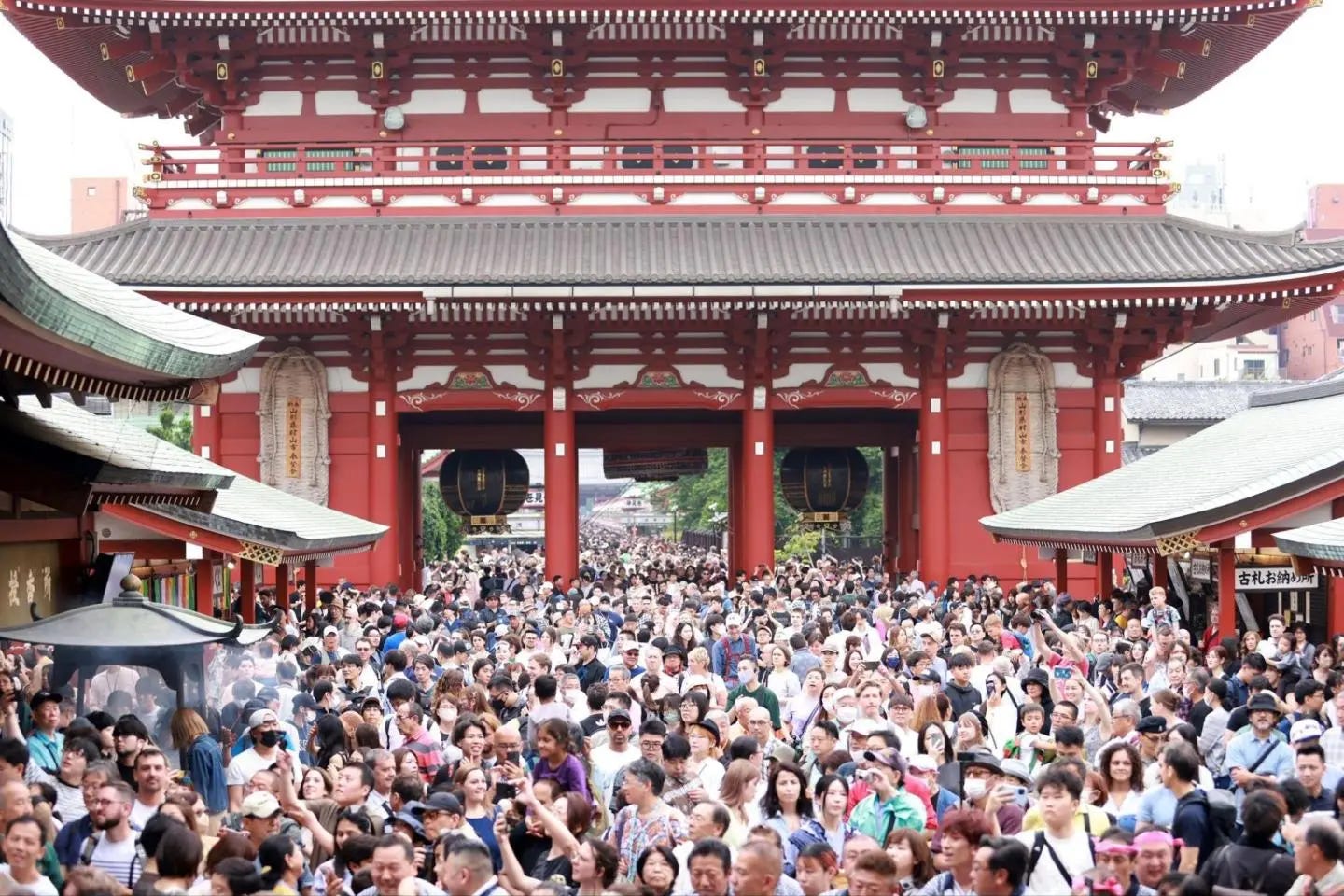
But as a wise man once told me, be careful what you wish for. This mega inflow of tourists has not gone unnoticed by the locals. There are loads more foreigners. There are more lines. There is more chatter on the subway. There is more trash on the streets. The Japanese are shocked and appalled. The hate for tourists has reached a boiling point. Japanese people are actively voting in politicians who are promising to curb this “invasion”.
This leads me to the main question this article aims to answer: Behind all the headlines about the “harm” of overtourism, how much money is Japan actually making, and can its economy survive without it?
The End of the Japan as the world’s factory
To understand why the government is so eager to flood Japan with tourists, you must understand the absolute desperation of the Japanese economy. After World War II, Japan built its national identity on being a global industrial powerhouse. They built great physical things. Toyota, Honda, and Sony conquered the globe. This industrial machine made Japan absurdly rich.
We often talk about the 1989 Japan bubble burst, but the truth is that even by the year 2000, Japan had the second-highest GDP per capita on Earth! Only Luxembourg was richer.
But then the demographic cliff hit. The population aged and birth rates collapsed. You cannot grow a domestic market when your consumers are physically evaporating. On top of that, Japan’s traditional export model also came under severe threat from Chinese electric vehicles and American software. The country desperately needed a backup engine.
Shinzo Abe made a highly rational calculation: Japan held an absolute monopoly on the physical Japanese cultural experience, and the global middle class was booming. The government pivoted from exporting physical machines to exporting an experiential service. To monetize this monopoly, Abe set an extremely ambitious goal of 60 million annual tourists by 2030 and got to work. His administration aggressively relaxed visa restrictions, expanded airport infrastructure, and secured the 2020 Tokyo Olympics to serve as the ultimate global billboard.
Then, COVID-19 smashed those dreams overnight.
But a blessing in disguise emerged from the ashes of the pandemic: A massive structural shift in global finance. Between 2021 and 2024, the Japanese yen fell by more than 50% against the US dollar. This historic currency collapse acted as jet fuel for a global population starved for travel.
A collapsed currency is a nightmare for Japanese citizens buying imported food, but it is an absolute dream for foreign tourists holding dollars. Japan instantly went on a fire sale. Tourists reacted logically to this massive arbitrage opportunity and swarmed the country. Japan welcomed a staggering 42.7 million international visitors in 2025, officially transforming into a discount theme park for the global middle class.
There s no such thing as free tourist money
Millions of tourists create massive congestion externalities. Cities are built for continuous occupancy by residents, not a constant rotation of transient visitors. Tourists largely pack themselves into the Golden Route of Tokyo, Kyoto, and Osaka. A staggering 69% of all foreign overnight stays happen in just these three metropolitan areas. The local infrastructure simply breaks under this weight.
The locals are furious. They cannot get on their own public buses in Kyoto. They deal with trash on their streets in Shibuya. They get all the negative externalities, but they do not get the direct profits. Hotel wages remain incredibly low. Foreign booking platforms like Agoda siphon away up to 20% of hotel revenues in commissions. The local resident gets the traffic, while the corporate entity gets the cash. The anger toward tourists is a completely rational response to this broken incentive structure.
The days of Shinzo Abe’s love for tourism are long gong… With the new prime minister Sanae Takaichi taking power with a nationalist mandate, she is actively implementing strict barriers to curb the tourist numbers. Takaichi knows that bashing foreigners and promising strict controls is currently excellent politics.
The government is aggressively using taxation to filter out budget travelers. They finalized a plan to triple the international departure tax. Starting in July 2026, it will cost 3,000 yen for every single person leaving the country. They are forcing visa-exempt travelers to pay for a new JESTA electronic authorization system by 2028. Local governments are eagerly joining this restrictive push. Kyoto City is jacking up its local accommodation tax to a brutal 10,000 yen per person, per night for luxury stays starting in March 2026. The goal is entirely transparent. They want fewer physical bodies entering the country while extracting significantly more cash from the rich ones who still decide to come.
But can Japan actually afford to turn these tourists away?
The data reveals a terrifying dependency: Tourists spent a record-breaking 9.5 trillion yen inside Japan in 2025. Depending on exchange rates, that equals roughly 63 billion US dollars. Tourism is officially Japan’s second-largest export sector. In fact, just the tourist ramen sector now brings more foreign capital into the economy than the entire Japanese steel industry.
Even if Japanese people suffer overtourism, this is still capital that enters the Japanese banking system. The government still taxes all the transactions. The 9.5 trillion yen is real money holding up the broader economy.
The GDP effect of tourism in Japan
The exact dent this tourism revenue makes is highly measurable:
Total tourism consumption within Japan reached 34.3 trillion yen in 2024. This massive footprint accounts for roughly 5.6% of Japan’s entire GDP. Inbound spending alone contributed half of Japan’s full-year GDP growth rate in 2023. Without the cash injection from foreign tourists, the Japanese economy would have experienced complete stagnation.
Japan desperately needs this marginal growth because the country is slowly becoming poor on a per-person basis. In 2000, Japan was the second richest country in the world. Now, the International Monetary Fund projects Japan’s GDP per capita will hit just $35,703 in 2026. Japan has plummeted to 40th in the world for nominal GDP per capita.
Look at exactly how far Japan has fallen behind:
South Korea: $37,412 GDP per capita
Lithuania: $36,545 GDP per capita
Brunei: $36,288 GDP per capita
Japan: $35,703 GDP per capita
Portugal: $35,434 GDP per capita
What happens if Takaichi actually manages to stop tourism?
We are watching that live experiment unfold right now. Following Takaichi’s diplomatic comments regarding Taiwan in late 2025, Beijing effectively boycotted Japanese travel. Chinese arrivals crashed 61% in January 2026. The localized economic damage was immediate. Chinese travelers traditionally account for 20% of Japan’s total tourism revenue. Their sudden absence triggered micro-recessions in major retail districts, and department stores watched high-margin luxury sales evaporate overnight.
But the broader tourism machine barely stuttered. Massive visitor surges from South Korea, Taiwan, and the US cushioned the blow, pulling the overall drop in foreign visitors down to just 4.9%. The retail sector bled. The rest of the country stayed full.
This shows exactly how hard it will be for the Japanese government to restrict tourism as long as Japan remains this cheap. Global demand is simply too strong to be deterred by the loss of a single demographic.
Covid meltdown
If the Takaichi government is actually serious about halting the crowds, piecemeal restrictions will fail. They need a total border shutdown.
To see what happens when tourism goes to absolute zero, look at the 2020 Covid-19 border closures. The exact cost of losing international tourism in 2020 included the following brutal metrics:
Japan lost 33 million inbound tourists in a single year.
The economy suffered 3.44 trillion yen in direct value-added losses.
Nearly 870,000 jobs simply disappeared.
People complaining about crowded buses in Kyoto must realize the alternative is economic starvation. You cannot transition a million hospitality workers into other domestic industries. The internal market is shrinking too fast to absorb them.
The inevitable acceptance
Japan backed itself into this corner because Japan is dying. In 2025, the population of Japanese citizens fell by over 900,000 people; that is a population the size of Austin, Texas every single year.
As such, the domestic market is a rapidly shrinking pie. The only mathematical way to generate aggregate wealth is to pull fresh money in from the outside world. Tourism is the ultimate un-outsourceable service. A tech company can offshore coding to India. You cannot offshore the physical experience of walking through a shrine in Kyoto. Japan holds an absolute monopoly on its own culture, and they must sell it to survive.
Sadly for Japan, people here are learning that exporting a service requires very different social sacrifices than exporting physical goods. When you build cars, you keep the factories hidden in industrial zones. The money arrives quietly via wire transfer. When you export tourism, the factory floor is the local neighborhood sidewalk. It is loud, it is messy, and it alters the local culture permanently.
The locals will complain loudly. The politicians will pass departure taxes and accommodation fees to appease the angry voters. But at the end of the day, Japan will keep the doors wide open. They will look at their shrinking bank accounts and their empty rural towns, and they will take the 9.5 trillion yen sitting right on the table.
Surviving as a loud, crowded theme park is fundamentally better than quietly starving to death.


