
Worse Than Kodak: The Inside Story of Toshiba's Self-Inflicted Extinction
It takes a special kind of incompetence to spin off your best asset right before it becomes Japan's most valuable company
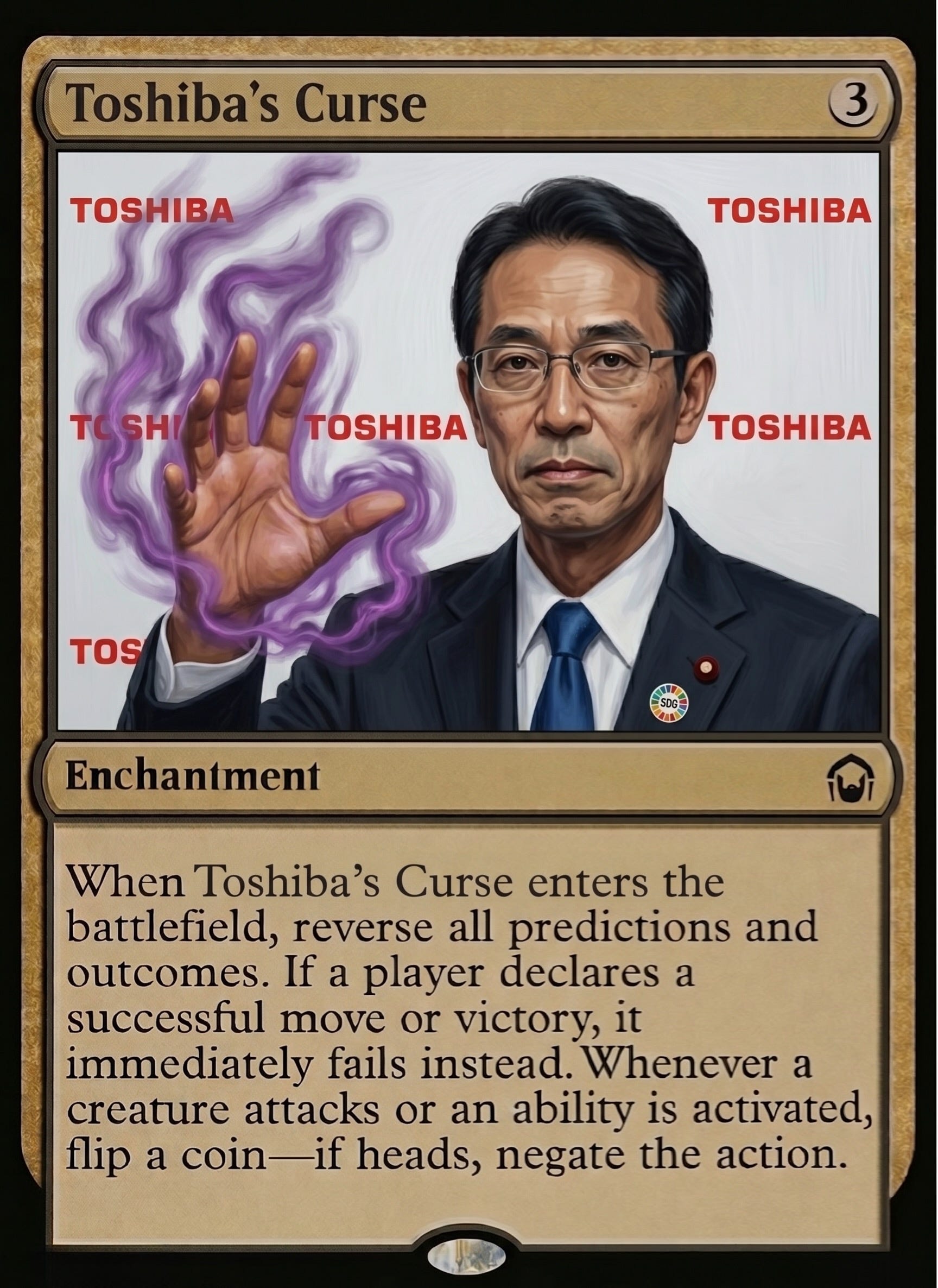
It’s as if Toshiba angered the Greek gods and caught a reverse Midas touch…Instead of gold, everything they touched turned to ash. They championed HD DVD right as the entire planet switched to Blu-ray. Then they paid an insanely criticized premium to buy the US nuclear firm Westinghouse in 2006, betting their entire fortunes on a global nuclear renaissance.
Then came March 11, 2011. A massive earthquake knocked out power at Fukushima Dai-ichi nuclear power plant. The tsunami flooded back-up generators, causing reactors to overheat and eventually started the worst nuclear meltdown since Chernobyl. The disaster froze the nuclear industry overnight and dragged Toshiba into total financial ruin.

Out of this nightmare of generational corporate incompetence rose Kioxia. To pay off those self-inflicted radioactive debts, Toshiba spun off their memory division for absolute scraps to Bain Capital in 2018. Now, Kioxia just surpassed Toyota as Japan’s most valuable company.
To understand how a discarded division turned into a financial monster, you have to look at the breathtaking sequence of blunders executed by its parent company.
It all started by punishing the man who invented the future
Dr. Fujio Masuoka is the reason you have a smartphone in your pocket. In the 1980s, he invented NAND flash memory while working at Toshiba. This is the exact architecture underlying every solid-state drive and modern AI data center today. It is arguably one of the most important technological breakthroughs of the twentieth century.
Toshiba management absolutely hated it. They were completely obsessed with magnetic hard drives and heavy machinery. They viewed Masuoka’s tiny silicon chips as a direct threat to their existing cash cows. They marginalized him immediately. They stripped him of his subordinates, moved him to a windowless office, and demanded he stop working on flash. Frustrated by the total lack of recognition, Masuoka quit in 1994 and settled for a mere $758,000. American competitors like Intel happily swept in, commercialized the technology, and generated billions. Toshiba eventually woke up, it was far too late.
They prioritized bureaucracy over technological revolution.
Toshiba’s toxic ego infected everything
I think Toshiba’s downfall truly began when they blindly gambled the farm on HD-DVD.
This is the early 2000s, Sony backed Blu-ray while Toshiba stubbornly championed its proprietary HD-DVD format. Toshiba thought they could win by selling cheaper standalone players, ignoring that Sony possessed far greater resources and incentives. To win the war in one swift strike, Sony swallowed massive hardware losses and embedded a Blu-ray player into every single PlayStation 3. Virtually overnight, millions of households were equipped with the format. Yet Toshiba refused to pivot, blindly fighting a war they had already lost. When Hollywood studios finally defected to Blu-ray, Toshiba was forced to abruptly kill the format, eating a billion dollars in totally avoidable losses.
Then they decided to play with nuclear energy. When Toshiba bought Westinghouse in 2006, the market value was estimated at under $2 billion. Toshiba somehow entered a bidding war against reality and paid $5.4 billion. They paid nearly three times what the company was worth just to flex their corporate muscles. Then Fukushima happened in 2011. Global reactor orders went to zero. Westinghouse began hemorrhaging cash. A sane management would cuts its losses.
Toshiba did not have a sane management… They doubled down, hid the bleeding, and kept building, and by doing so, engineered one of the largest accounting frauds in Japanese history to cover up their failures.
From 2008 to 2014, successive presidents issued impossible profit targets to division heads. They forced their subordinates to cook the books, artificially inflating operating profit by over $2 billion. When the scandal broke in 2015, Toshiba's stock went into a freefall. Top executives resigned in disgrace. The hollowed-out company was immediately hit by the bankruptcy of its Westinghouse subsidiary, taking on nearly $9 billion in losses and fighting just to survive.
To survive their own financial ruin, Toshiba accidentally built a semiconductor God
Facing total bankruptcy, Toshiba had to sell off the only thing making them real money. In June 2018, they sold a majority stake in their memory division to a Bain Capital consortium for $18 billion. They rebranded the scraps as Kioxia.
The company was chugging along, barely making a profit until the generative AI boom hit in 2024. You see, to train large language models, tech giants have to feed them oceans of data instantly. That requires absurd amounts of high-capacity, lightning-fast solid-state storage.
Because of Dr. Masuoka’s original invention, Kioxia practically owns the foundational DNA of NAND flash. When massive hyperscalers panicked to build new data centers, they realized Kioxia was one of the only suppliers on earth capable of meeting their insane demand. Kioxia became a mandatory tollbooth on the AI highway.
The financial reaction was violent. Kioxia launched its IPO in December 2024 at a $5.6 billion valuation. Since its initiation, the stock has exploded by over 4000%. Revenue jumped from ¥1.706 Trillion in FY2024 to an estimated ¥7.877 Trillion in FY2026. Operating margins swung from negative 23.4% to a massive positive 74.3%.
Toshiba’s public investors won’t see a single cent of this goldmine.
Toshiba technically still holds a massive chunk of Kioxia’s shares. That stake is theoretically worth over $100 billion today. You would think this monster rally would save Toshiba’s public stock price. It doesn’t. Toshiba is no longer a publicly traded company.
After years of furious activist investors demanding change, a private consortium took Toshiba private for $14 billion in late 2023. They delisted the company from the Tokyo Stock Exchange entirely. The retail investors are completely gone. The public equity markets cannot price in this windfall.
The only people reaping the rewards of this historic surge are private equity firms. Bain Capital stands to bank an estimated $15 billion in pure profit while retaining a huge chunk of equity and control. The financial windfall of the century, created by Toshiba’s own flash memory invention, was surrendered to private equity just moments before the AI revolution took off…
One thing that is still intact is Toshiba’s legacy: Everything they believed in turned to ash, and the one thing they threw away turned to gold.


It's positie to benefit from Toshiba - Kioxia through Orix. They own ~17% of Toshiba.