
How Inflation is Wiping Out Japan's National Debt
Is the Japanese government paying off their debt at the cost of their population?
Japan is the undisputed heavyweight champion of national debt.
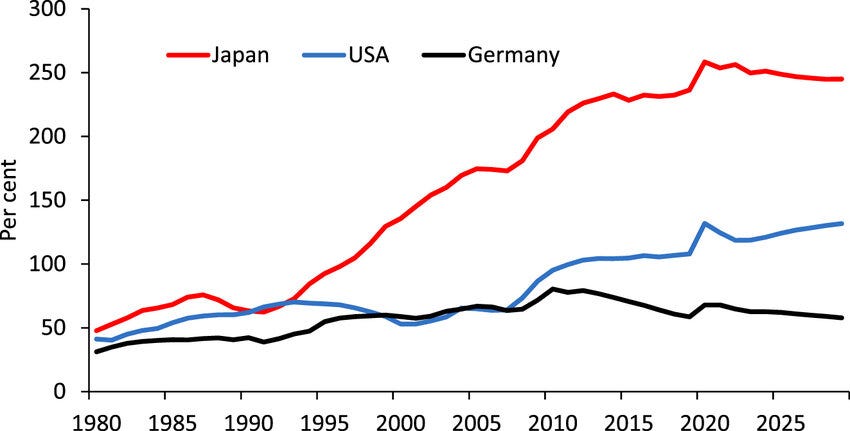
The numbers are so large they almost lose their meaning. We are looking at a nominal gross domestic product of roughly 665 trillion yen as of 2025, stacked against a gross government debt of 1,342 trillion yen. Depending on the metric, the government debt-to-GDP ratio sits between 230% and a staggering 248.7%.
While the world has been waiting for Japan’s government to collapse under the world’s heaviest debt burden, I wonder if everyone is looking at the Japanese debt situation completely backwards.
Japan is a deeply weird economy, and its debt is uniquely structured. Unlike the sovereign debt of emerging markets or even some European nations, Japan’s debt is almost entirely held by its own citizens and domestic institutions. Furthermore, it is entirely denominated in the Japanese yen. This means the risk of a classic sovereign default (where a country simply runs out of foreign currency to pay its foreign creditors) is zero. But even acknowledging that reality, a 248% debt-to-GDP ratio still sounds terrifying.
But things might have turned to Japan’s favor. We are witnessing something in Japan that has not happened in decades. Inflation has returned with a vengeance. Prices are rising, the yen is dropping like a rock, and the Bank of Japan is caught in a brutal policy trap.
After all, inflation is the debtor’s ultimate friend. Because the Japanese government is the largest debtor in human history, this inflationary spike might actually be a hyper-efficient mechanism for liquidating decades of accumulated debt.
Just to prove my point, Japan’s debt-to-GDP ratio has actually been falling since September 2020:
But first, a history lesson how we got here:
How Japan’s debt mountain was built
To understand why this inflationary write-off is possible, we first have to understand how Japan built this mountain of debt in the first place. The story of the Japanese economy is a story of perfectly rational actors responding to deeply broken systems.
In the late 1980s, Japan experienced one of the biggest asset bubbles in history. Real estate and stock prices soared to absurd heights. When that bubble inevitably burst in the early 1990s, it wiped out trillions of yen in paper wealth. The private sector was left holding massive liabilities against assets that had plummeted in value.
The private sector responded in a completely rational way. Corporations and households stopped borrowing and started saving aggressively to repair their balance sheets. When everyone in an economy tries to save money and pay down debt at the exact same time, consumer spending drops. Economists call this a balance sheet recession.
The Japanese government stepped in to fill the void. The government became the borrower and spender of last resort. Tokyo initiated massive public works projects, infrastructure spending, and endless stimulus programs to keep the economy from slipping into a deflationary depression. The government ran budget deficits throughout the 1990s and 2000s, and the debt-to-GDP ratio began its relentless upward march.
This government spending was quickly compounded by a massive demographic shift. The Japanese population began to age rapidly. The birth rate collapsed, and life expectancy increased. This created a structural nightmare for the government budget. The number of retirees grew, requiring massive increases in pensions, healthcare, and social security spending. Meanwhile, the base of active, tax-paying workers began to shrink.
The only politically viable solution was to borrow the difference.
Japan’s debt is funded by Japanese people
If any normal country tried to run persistent deficits for three decades, the international bond markets would eventually revolt. Investors would demand higher yields to compensate for the risk of default, and the country would be forced into painful austerity. This did not happen in Japan.
Japan was protected by a unique closed-loop financial system. The massive budget deficits run by the government were seamlessly financed by the equally massive savings of the domestic private sector. Japanese corporations, terrified of another balance sheet crisis, hoarded cash and bought government bonds. Japanese households, culturally conditioned to save and facing a highly uncertain future, deposited their money into postal savings accounts and domestic banks. Those banks then turned around and lent that money to the government by purchasing Japanese Government Bonds.
The system operated in perfectly balanced stagnation. The government borrowed endlessly to fund a stagnant economy, and the private sector happily parked its savings in ultra-safe, low-yielding government bonds.
Eventually, the Bank of Japan decided to take this system to its logical extreme. To fight the persistent deflation that was plaguing the economy, the central bank initiated a policy of quantitative easing. The Bank of Japan began buying massive quantities of government bonds directly from the market. By 2013, the central bank was explicitly trying to force economic growth and inflation through this massive asset purchasing program.
The central bank eventually implemented a policy known as Yield Curve Control. The Bank of Japan essentially promised to buy an unlimited amount of government bonds to keep the yield on the 10-year bond pinned near zero percent. This was a massive intervention in sovereign debt markets.
The result was that the Japanese government was able to borrow essentially for free. Even as the principal balance of the debt ballooned to over 200% of GDP, the actual interest payments required to service that debt remained incredibly low. The interest expense hovered around a mere 1% of GDP. The government owed an astronomical amount of money, but the cost to carry that debt was practically a rounding error.
Furthermore, the Bank of Japan became the largest single holder of Japanese debt. The central bank now holds nearly half of all outstanding Japanese Government Bonds. When the national government owes money to the national central bank, the concept of a sovereign debt crisis begins to lose its traditional meaning. The left pocket simply owes the right pocket.
Then inflation hit Japan!
This perfectly balanced system of low growth, zero inflation, and zero interest rates was deeply unnatural. It relied on a globally integrated supply chain that provided cheap manufactured goods and stable energy prices. Over the past few years, that global order has fractured.
Supply chain disruptions, geopolitical conflicts, and shifting energy markets have reintroduced inflationary pressures to the entire global economy. Japan, which imports the vast majority of its energy and raw materials, has not been spared. The era of zero inflation is officially over. Prices are rising, and the Japanese yen has depreciated significantly against the US dollar and other major currencies.
When a currency drops aggressively in value, a nation that relies heavily on imports will inevitably experience imported inflation. The cost of fuel, food, and basic commodities surges. The Bank of Japan now faces an impossible dilemma.
If the central bank raises interest rates aggressively to defend the value of the yen and crush inflation, it risks triggering a massive repricing of the domestic bond market. The government would suddenly face a staggering increase in debt service costs, and the heavily leveraged corporate sector would face a wave of bankruptcies. If the central bank keeps interest rates low to protect the government’s balance sheet, the yield differential between Japan and the rest of the world remains wide. This drives the yen even lower, which in turn imports even more inflation.
The central bank has predictably chosen the path of least resistance. It has made slow, cautious adjustments to its policy rate, but the broader monetary stance remains very loose compared to the rest of the world. The yen has been left to bear the brunt of the adjustment, dropping like a stone in international currency markets.
This is really bad for Japanese people which are quickly becoming poorer and able to buy less every day. Inflation is indeed a tax on the consumer, but it is also a massive wealth transfer from the creditor to the debtor. The Japanese government is the largest debtor in the world.
For Takaichi’s government, inflation is not a bug in the system, it is a feature, and I think they are fully aware that they’re saving themselves at the cost of the Japanese people. I think they are banking on inflation remaining stubbornly high, because it will write down the massive government debt faster than they can take on new debt.
However wrong this is, it might just make Japan as a whole better equipped for the future.
The Race Against Time
When a government holds interest rates below the rate of inflation, it is effectively pulling off a stealth default on its creditors. The government repays its bondholders in full, exactly as promised. But the yen it uses to make those payments has lost a substantial portion of its purchasing power. The domestic bondholder suffers a deeply negative real return, and the government enjoys a massive reduction in its real debt burden.
This mechanism perfectly explains the agonizingly slow response of the Bank of Japan over the past two years. I firmly believe that the Japanese central bank is attempting to have inflation run hot while keeping long-term bond yields relatively contained, which will naturally deflate the debt-to-GDP ratio.
And we are already seeing proof of this. Nominal tax revenues in Japan have been soaring. As wages and corporate profits increase with inflation, the government collects more nominal tax revenue. This is known as fiscal drag. Because these taxes are collected in depreciating yen, Japan’s general account tax revenues have recently hit record highs, exceeding 70 trillion yen. Meanwhile, the interest expenses on the debt rise much more slowly, buffered by that 9.5-year average maturity.
As discussed above, the gross public debt, which peaked at over 260% of GDP during the pandemic, has already shown signs of stabilizing and declining as nominal growth outpaces interest costs. The government is successfully inflating away the debt right now. The International Monetary Fund (IMF) projects that this mathematical advantage will steadily shrink Japan’s public debt-to-GDP ratio to roughly 193% by 2031.
But there is a catch. The mathematical salvation has a strict expiration date. The IMF notes that by 2035, the debt ratio is projected to reverse course and start rising again.
The debt write-off only works because the old debt is locked in at low rates. Eventually, those old bonds mature. With an average maturity of 9.5 years, roughly 10% of the Japanese government bond portfolio rolls over every single year. When those old zero-percent bonds mature, the government has to issue new bonds to replace them. And those new bonds have to be sold at the new, higher market interest rates.
The market is already demanding a higher premium. The yield on the 10-year Japanese government bond has crept upward, and the yield on 20-year bonds has recently tested extreme levels around 2.75%. Every time an old bond is replaced by a new 2.75% bond, the government’s interest expense ticks higher.
The Problem with New Spending
This race against time is complicated by the fact that Japan is still actively digging the hole deeper. The government is not running a balanced budget. It consistently spends more than it collects in taxes, even before we look at the interest payments. This is the primary deficit, and it remains a massive structural problem.
The primary deficit is projected to remain elevated around 2% of GDP in the coming years due to intense upward pressure on public spending. Inflation makes this problem worse in the immediate term. When prices rise rapidly, the government is forced to spend more nominal yen to maintain basic services. The cost of public infrastructure projects skyrockets.
More importantly, the government faces intense political pressure to shield the public from the pain of inflation. Takaichi and the Liberal Democratic Party (LDP) is acutely aware of voter anger over the rising cost of living. They are already rolling out massive fiscal stimulus packages, energy subsidies, cash transfers, and are discussing consumption tax cuts to ease the burden on households.
Suspending the consumption tax on food for two years, for example, is a politically popular move. But it blows a massive hole in the budget. The government has to issue new debt to cover that shortfall.
Furthermore, the demographic reality is inescapable. The aging population guarantees that social security and pension expenditures will continue to climb. Pensions in Japan are generally indexed to macroeconomic indicators, meaning that as prices and wages rise, the government’s nominal obligations to retirees rise in tandem. The government has also committed to significantly increasing defense spending to counter shifting geopolitical threats in East Asia.
All of these factors ensure that the government must continue to issue tens of trillions of yen in new debt every year just to keep the lights on.
The debt write-off from this inflation advantage easily outpaces the new spending in the short term. The sheer mathematical force of inflating a denominator of 665 trillion yen dwarfs a primary deficit of a few trillion yen. But if inflation persists for a decade, and the entire debt portfolio reprices at much higher interest rates, the compounding cost of the new debt and the higher interest payments will eventually overwhelm any benefits of the write-off.
The Japanese government is walking a tightrope over a very deep canyon. It is utilizing inflation to liquidate the mistakes of the past, but it must fundamentally reform its spending habits to avoid creating an even larger crisis in the future.
But to conclude my initial point, Japan is currently engaged in the greatest stealth default in modern economic history. The mountain of debt that has terrified analysts for decades is slowly being liquidated. It is a messy, volatile, and painful transition. But it might be the only resolution to an otherwise unsolvable structural trap.


