


Disclaimer: This content is for informational purposes only, not investment advice. I may own equities mentioned in this article. Investing involves risk, so always do your own research before buying or selling any securities.
Every person with an internet connection now has access to the most incredible investing tool in history, AI.
AI can process every number and perform every stock valuation calculation, no matter how complex or how much data is needed. That super duper crazy complex DCF valuation formula you’ve cooked up that worked so well for the past 10 years? Now your nephew can run it on his phone between classes.
Which makes it useless.
When everyone knows the trick, the trick stops working
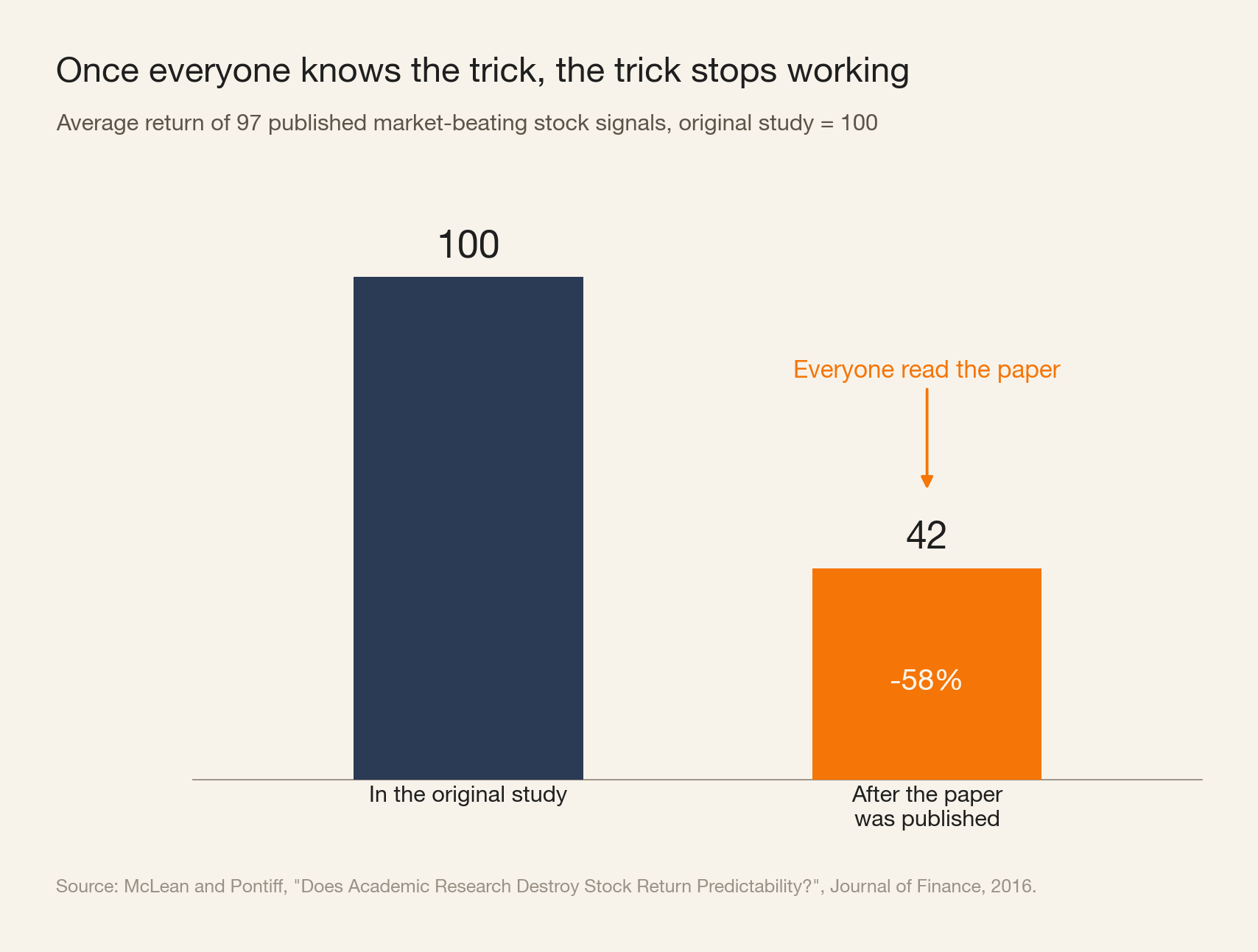
The research backs up what I’m saying. In 2016 two finance professors, David McLean and Jeffrey Pontiff, took 97 stock signals that academics had proven could beat the market, and checked what happened to them later. After publication, returns were 58% lower.
The signals still worked on paper, but the problem was that everyone had read that paper.
Now imagine a paper that gets republished to 1.2 billion people every week, rewritten on demand, in whatever language you like. That’s what AI is.
What humans want, humans get
Human emotions are, as we all know, very flawed. We gamble when we know the house always wins, we eat delicious chocolate that makes us “feel good” despite the scale telling us we’re fat. I mean, we even go into debt buying luxury watches when we have a more accurate clock in our pockets at all times!

But, at the end of the day, every company, no matter how complex, has a human as the end customer.
Tokyo Electron sells machines to TSMC. TSMC makes chips for Apple. Apple sells an iPhone to a 16-year-old in Shibuya who wants one because all her friends have one.
Strip away the complex abstractions, business plans & supply chain and every dollar of revenue starts with somebody wanting something. So whether we like it or not, what humans want, humans get.
And that’s exactly why I think I can still beat AI in stock analysis: AI lacks the thing that drives every purchase on earth: It has never wanted anything.
You see, GPT (which all modern LLM AI’s are built on) stands for Generative Pre-trained Transformer. In layman terms, modern AI is a machine that has read almost everything humans have ever written to predict the most likely next word.
AI can describe a chocolate craving beautifully because millions of us have written about one. Yet AI has never had a single craving. Instead of feeling the world, a model just averages the words we have already used to describe it. And in the stock market, the average of what everyone has already said has a name: Consensus.
Hence, blindly following AI makes you average at best. I’m betting my human gut feeling can beat the average, here’s how:
The KonichiValue Framework
So let me introduce my new baby: the KonichiValue Framework!
It has four steps:
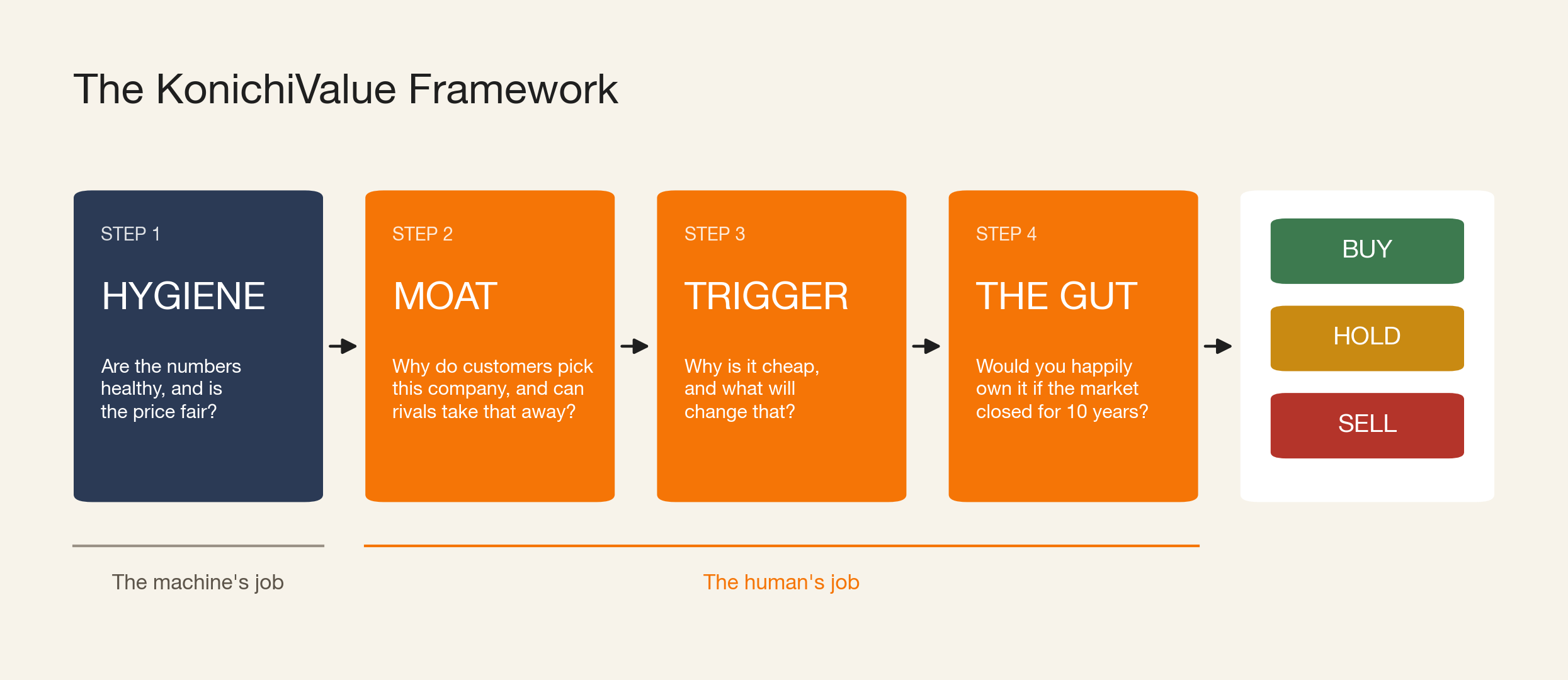
Step 1 is pure numbers, which is tailerd for AI models and data screeners to syphon through.
Steps 2 to 4 are where my gut comes in, and that’s where the contrarian arbitrage is to be had. In other words, it’s where I beat AI!
Step 1: Hygiene. The numbers can only say no
I stole most of this one from the Swedes, because in my biased view, they are the world’s best value investors. Kvalitetsaktiepodden, Sweden’s best value investing podcast, has the cleanest definition of a quality company: Steady growth, a balance sheet that isn’t stretched, at least five years public, and a business “in a position to control its own destiny” (yeah, oil companies are out).
For price, I use Vitaliy Katsenelson’s Absolute P/E from Active Value Investing, which starts every company at 8x earnings and adds points for growth and dividend yield. Perfect for Japan, where half the good companies pay you to wait. In addition, I use five-year average growth, capped at 15%, so one lucky year can’t sneak a stock through.
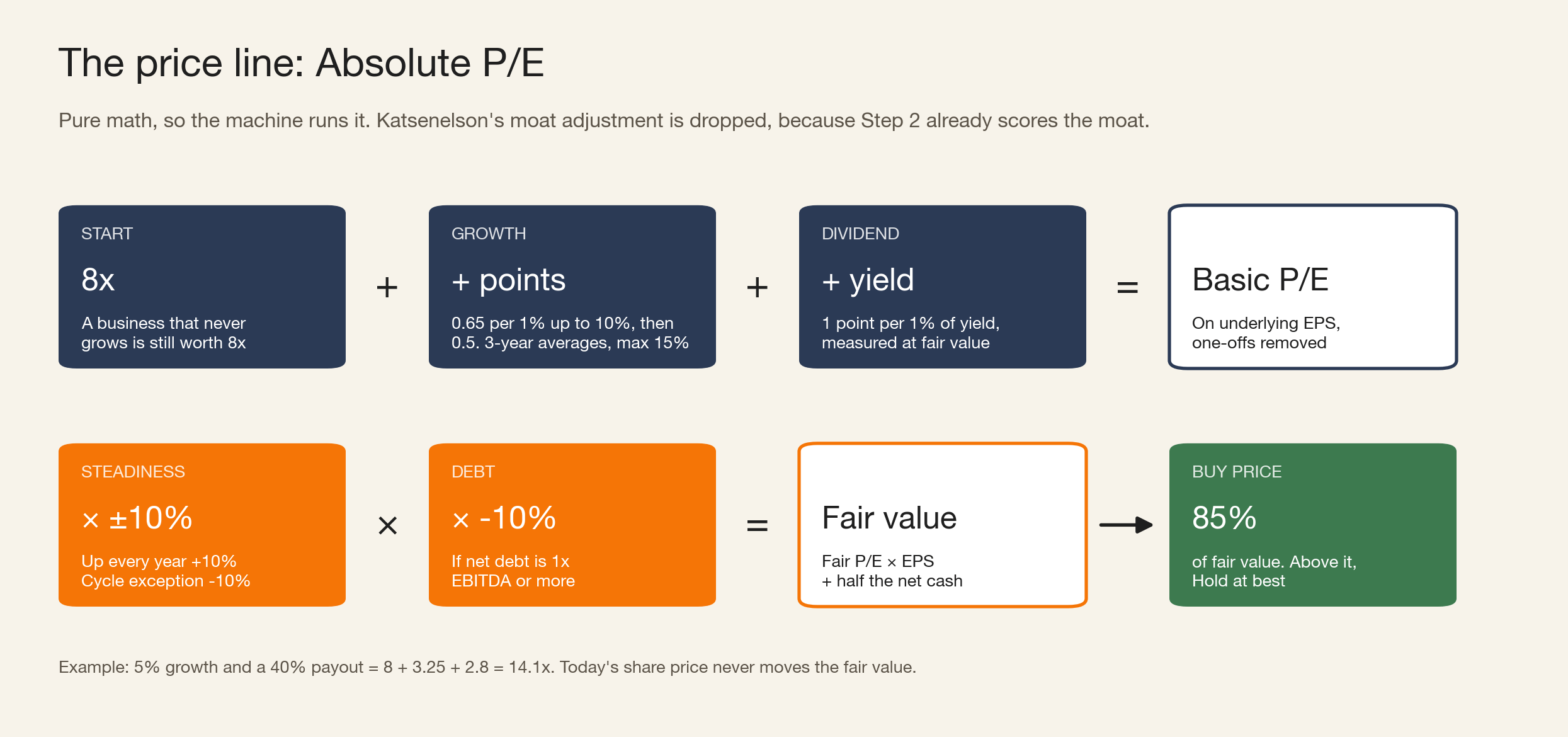
On top of that, I use mathematical formulas to be able to screen companies with AI: Steady growth adds 10% & a lumpy cycle or real debt takes 10% off. On top, I add half the company’s net cash, because Japanese cash doesn’t always come home to shareholders. As a baseline of this formula, I only consider companies buy-targets if they’re 15% or more below fair value.
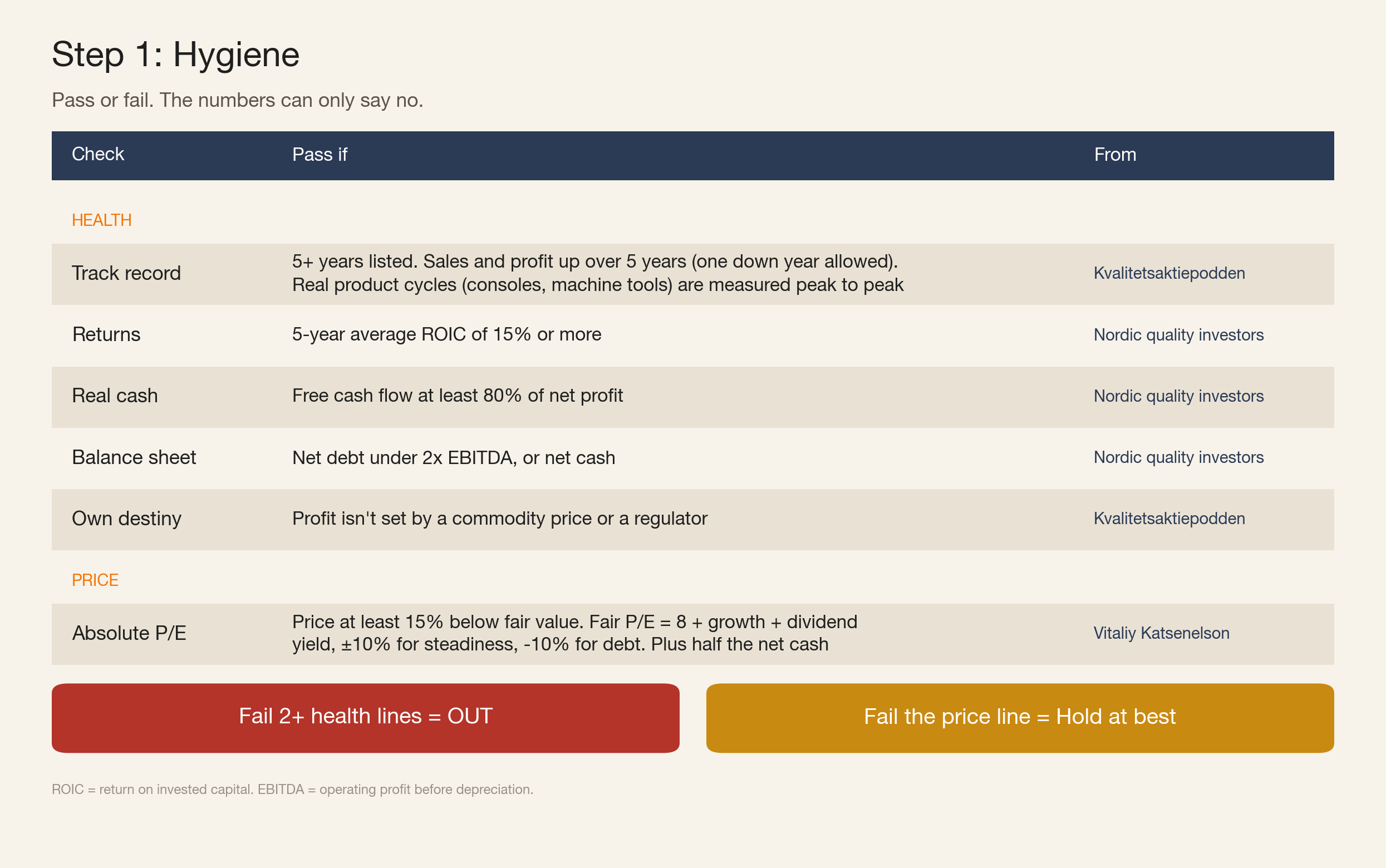
If the company fails two or more of these criteria, the stock is out! If it fails the price line, it can still be a wonderful company, but will not get a BUY rec today.
Step 2: The Moat. Why do customers pick this company, & can rivals take that away?
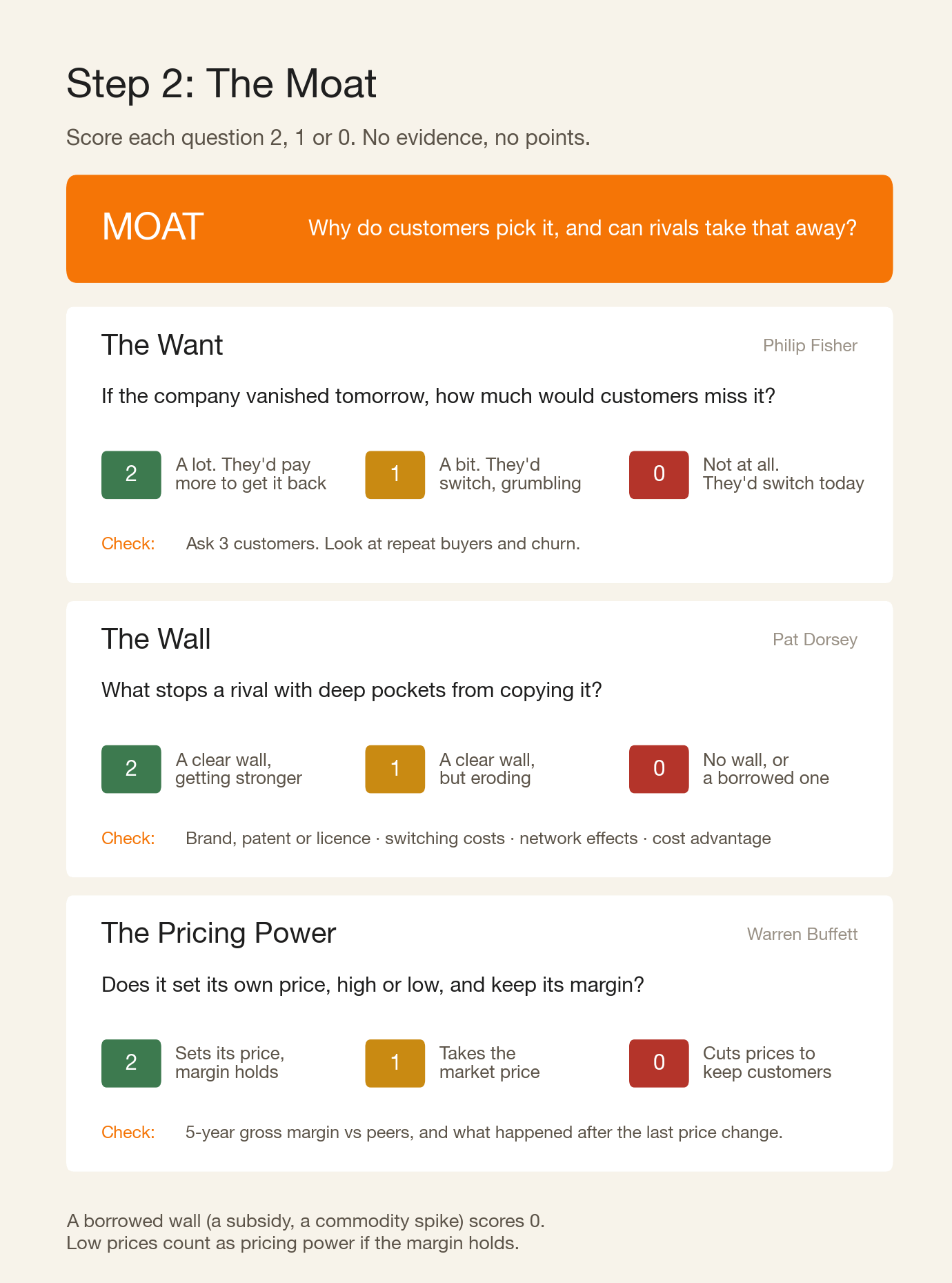
The step I care about most, and I’ve built it on Philip Fisher (Buffett once called himself 85% Graham and 15% Fisher).
Fisher’s big idea was “scuttlebutt”: Before he ever met management, he’d talk to customers, suppliers, competitors and ex-employees, and build his own picture of the company.
Three questions that are each scored 2, 1 or 0. Also, every score needs real evidence and cannot just be based on management talk or analyst expectations. No evidence, no points.
These are the questions:
The Want: If the company vanished tomorrow, how much would customers miss it? Would they pay more to get it back, or switch by lunchtime?
The Wall: What stops a rival with deep pockets from copying it, and is that wall getting stronger or weaker? Pat Dorsey, Morningstar’s former head of equity research, boiled real moats down to four: A brand, patent or licence, switching costs, network effects, and a cost advantage. Anything borrowed, like a subsidy or a commodity spike, scores zero.
The Pricing Power: Buffett has said multiple times that “the single-most important decision in evaluating a business is pricing power.” Does the company set its own price, high or low, and keep its margin?
That “high or low” really matters: Saizeriya held its ¥300 Doria for about six years while chain after chain raised prices, and its Japanese customer count grew 27% on 2019. When it finally raised prices 6% on October 29, the stock jumped as much as 14%. Being the cheapest on purpose is a moat too, as long as the margin survives it.

The Saizeria Doria; The cheapest way to get full in Japan

Step 3: The Trigger. Why is it cheap, & what will change that?
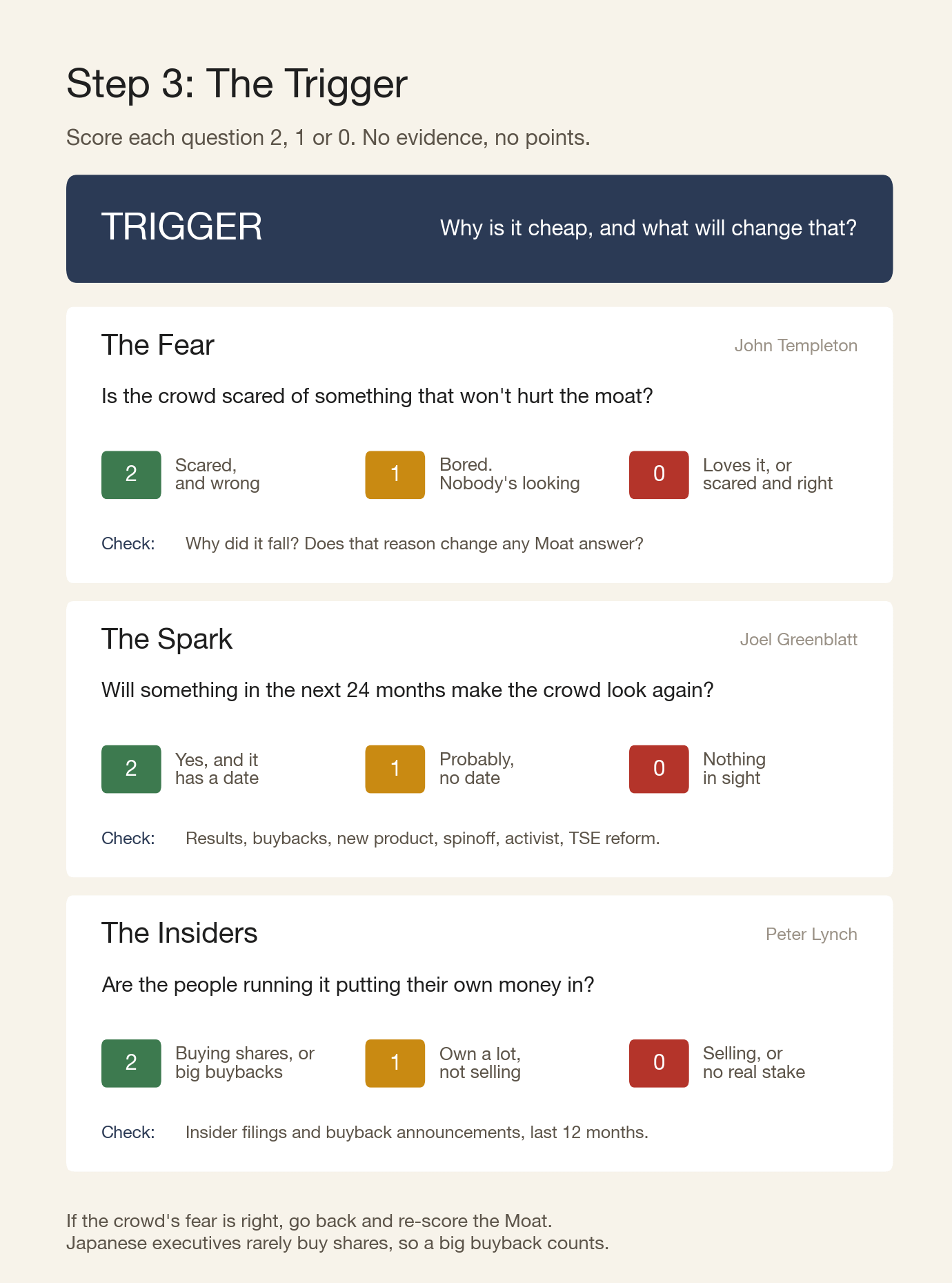
A great moat at the wrong moment is as useless as no moat.
To determine if the company has the right thing at the right time, I use these three questions:
The Fear: Is the crowd scared of something that won’t hurt the moat? John Templeton said the time of maximum pessimism is the best time to buy. An AI can tell you a stock fell 30%. It can’t tell you whether the fall came from panic or from truth, because to the AI, the panic IS the data.
The Spark: Will something in the next 24 months make the crowd look again? Joel Greenblatt built a career on these: spinoffs, buybacks, restructurings. In Japan, the best example of a spark is that since 2023, the TSE has been pushing companies that trade below book value to fix it.
The Insiders: Peter Lynch once said: “Insiders might sell their shares for any number of reasons, but they buy them for only one: They think the price will rise.” Japanese executives rarely buy on the open market, so a big buyback counts too. A CEO with no real stake scores zero.
Step 4: The Gut
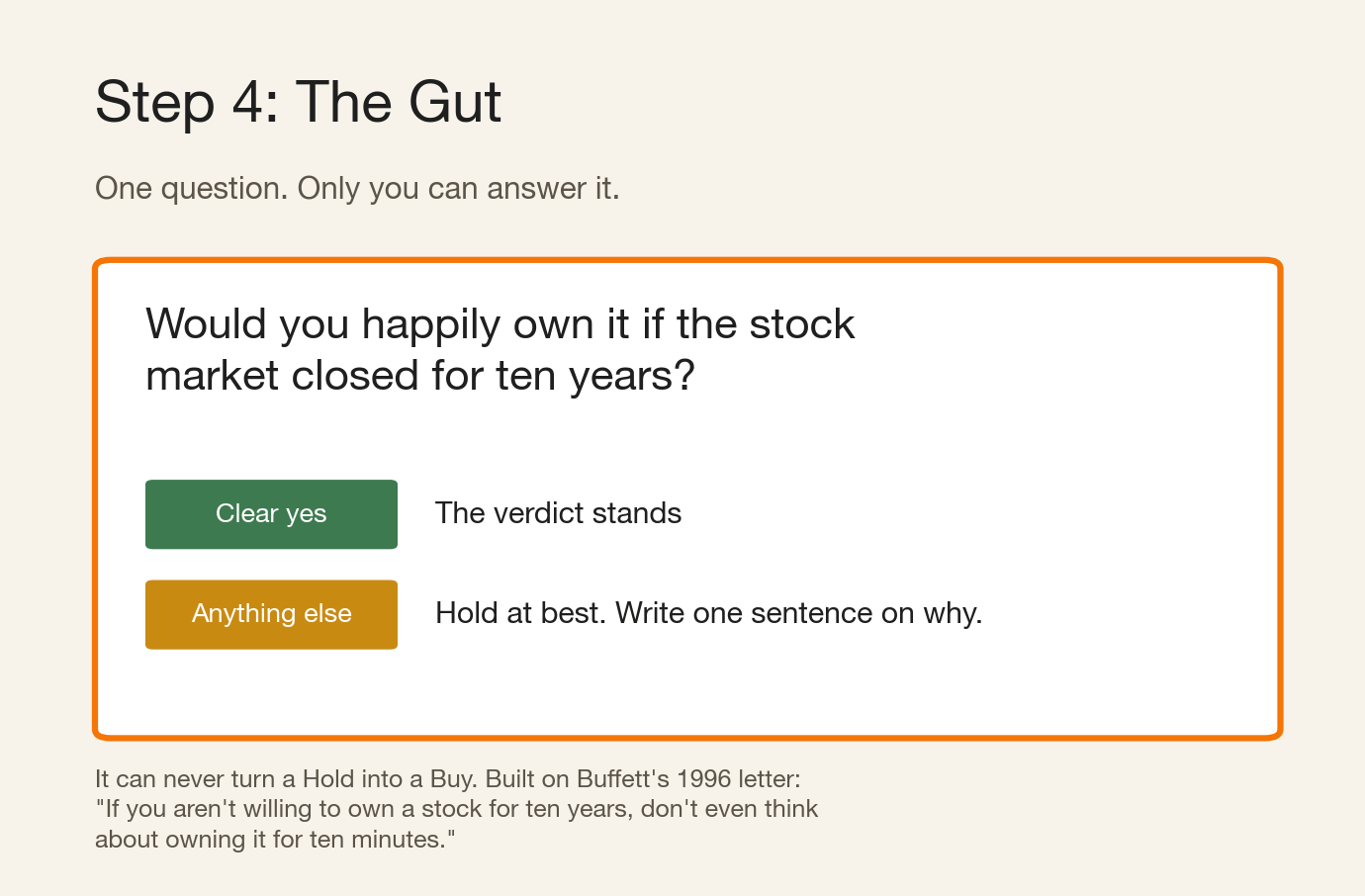
The final step: Would you happily own it if the stock market closed for ten years?
It’s Buffett’s 1996 letter in a new outfit: “If you aren’t willing to own a stock for ten years, don’t even think about owning it for ten minutes.”
If the answer is anything but a yes, the best this stock can get is a HOLD.
The verdict
I made this little grid so you can see how the framework works in practice:
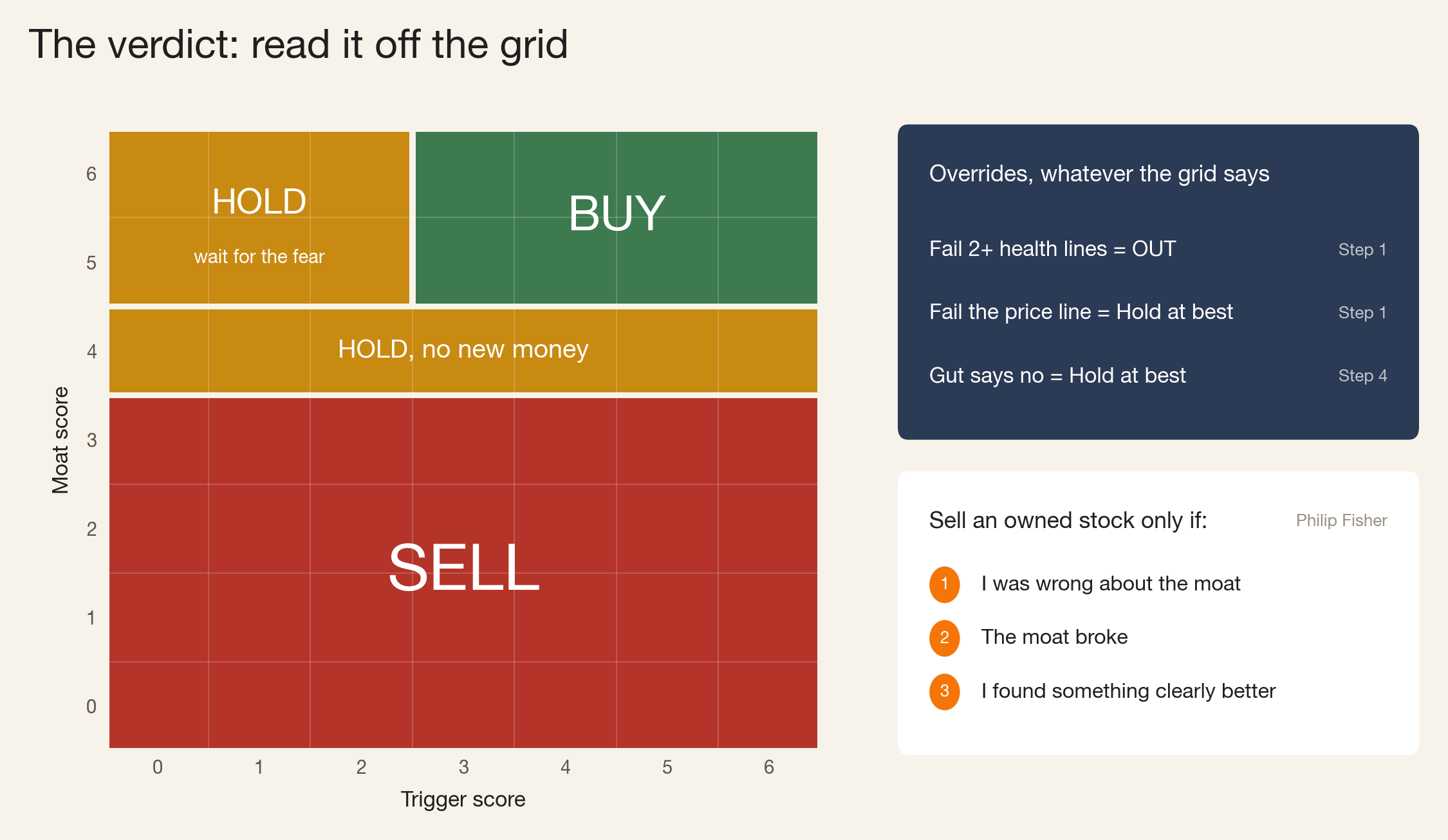
Buy: Moat of 5 or 6, and a Trigger of 3 or more.
Hold: Moat of 5 or 6 with a Trigger under 3. Own it if you already do, watchlist it if you don’t, and wait for the crowd to get scared.
Hold, no new money: a Moat of exactly 4.
Sell: a Moat of 3 or less.
Mark my words…
By the end of 2027, every Japanese online broker will have an AI robo-advisor in its app, and their Buy lists will look almost identical…
For fifty years, the investing industry has tried to take the human out of investing. Factor models, robo-advisers, and now AI. It has finally pulled it off. And the strange reward for taking the human out of the math is that understanding humans has become the only part of investing that still pays.
Sources: McLean and Pontiff, Journal of Finance (2016); Warren Buffett, FCIC interview transcript (May 26, 2010) and Berkshire Hathaway shareholder letter (1996); Kahneman and Klein, “Conditions for Intuitive Expertise: A Failure to Disagree”, American Psychologist (2009); Pat Dorsey, The Little Book That Builds Wealth (2008); Vitaliy Katsenelson, Active Value Investing (2007); Peter Lynch, One Up on Wall Street (1989); Kvalitetsaktiepodden via Unga Aktiesparare; Saizeriya price change via its press release (October 14, 2026) and ITmedia (October 29, 2026), customer numbers via Business Insider Japan (April 2026); ChatGPT weekly users via OpenAI DevDay (September 29, 2026). Nihon Seiko figures from my Value Screener article. This is a KonichiValue opinion piece and not investment advice. I own Nintendo.